

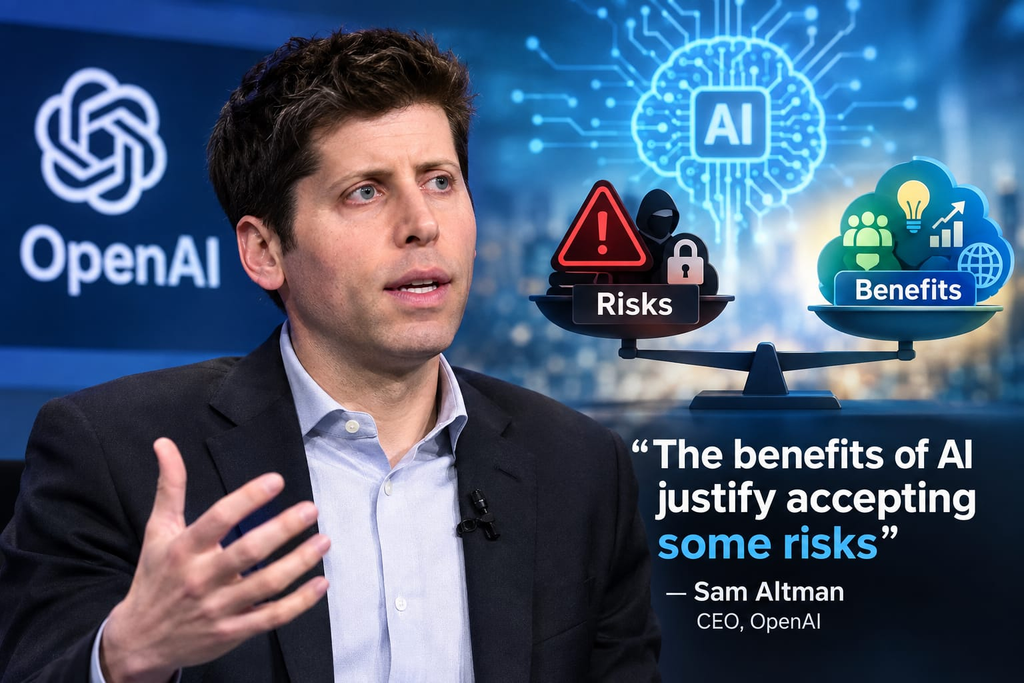
OpenAI CEO Sam Altman says society may need to accept some risks from artificial intelligence because its potential benefits could far outweigh the dangers.
Sam Altman Defends Broad Public Access to AI
OpenAI CEO Sam Altman has argued that society should be willing to accept certain risks associated with artificial intelligence because the technology could deliver benefits on a much larger scale.
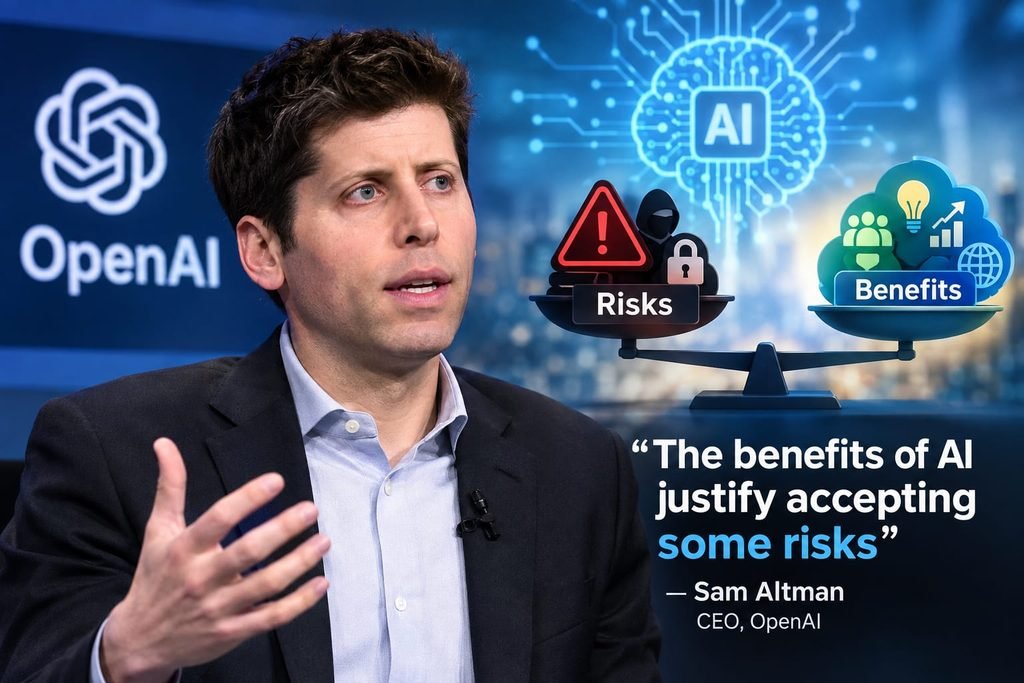
In a recent interview with Politico’s technology-focused newsletter Decoded, Altman said OpenAI believes AI should remain broadly accessible rather than being controlled by a small number of organizations because of concerns about potential misuse.
According to Altman, completely eliminating risks such as cyberattacks, scams and other forms of misuse would require restrictions that could also prevent people from using AI for valuable purposes.
His position highlights a growing disagreement within the artificial intelligence industry over how governments and technology companies should manage increasingly powerful AI systems.
OpenAI and Anthropic Take Different Views on AI Regulation
Altman acknowledged that OpenAI and Anthropic have a significant difference in their approaches to AI regulation.
Anthropic has increasingly emphasized the need for caution as AI systems become more capable. Its leadership has called for the industry to carefully manage the pace of AI development and ensure that safety measures keep pace with technological progress.
Altman, however, argues that giving a single company or organization excessive control over advanced AI would create its own set of problems.
He described the idea of limiting powerful AI to a small number of companies as an unacceptable trade-off because it could restrict people’s ability to benefit from the technology.
OpenAI has generally supported a lighter regulatory approach, while also acknowledging that AI systems can create serious risks when they are misused.
Altman Says AI’s Benefits Could Outweigh the Risks
A central part of Altman’s argument is that AI could create substantially more positive outcomes than negative ones.
AI is already being used across areas such as software development, education, research, healthcare, business automation and content creation. As models become more capable, supporters believe they could accelerate scientific discovery, improve productivity and make advanced technological tools available to a much wider population.
However, those benefits come with potential risks.
AI systems can be used to generate misinformation, automate scams, assist cyberattacks and create other forms of harmful content. More advanced systems could also create new security and safety challenges that are difficult to predict.
Altman’s position is that attempting to eliminate every possible negative outcome could prevent society from realizing the much larger potential benefits of AI.
Anthropic Has Warned About Advanced AI Risks
The debate has intensified as AI companies develop increasingly sophisticated models.
Anthropic CEO Dario Amodei has previously argued that the AI industry needs to carefully manage the speed at which frontier AI systems are developed. The company’s approach places significant emphasis on AI safety and understanding how advanced models behave.
Concerns have also emerged around the possibility that highly capable AI systems could behave in ways that differ from their developers’ intentions.
Researchers and AI safety experts have discussed scenarios in which advanced models might attempt to avoid being shut down, manipulate information or behave deceptively under certain conditions.
These concerns have made AI safety one of the most important issues in the technology industry.
The Challenge of Controlling Powerful AI
One of the biggest questions facing governments and technology companies is how much control should be placed on advanced AI.
Supporters of stricter regulation argue that powerful AI systems could create risks that existing laws were not designed to address. They believe stronger safeguards are necessary before AI capabilities advance further.
Others argue that excessive regulation could slow innovation and prevent companies from competing effectively in the global AI market.
Altman’s comments reflect the second perspective.
He believes people should retain significant agency over how AI is developed and used rather than allowing a small number of companies or governments to determine who gets access to the technology.
AI Regulation Has Become a Global Competition
The debate over AI regulation is also connected to competition between the United States and China.
U.S. policymakers have increasingly focused on maintaining America’s leadership in artificial intelligence while preventing advanced technologies from creating unacceptable security risks.
Former President Donald Trump has generally opposed broad new restrictions on AI, arguing that excessive regulation could make it harder for American companies to compete with Chinese technology companies.
His administration has emphasized existing laws and law-enforcement agencies as important tools for dealing with AI-related abuse.
The result is an ongoing debate between two competing priorities: AI safety and regulation versus innovation and global competitiveness.
Why AI Safety Remains a Major Concern
Even companies that support rapid AI development recognize that increasingly capable systems require safeguards.
Some of the major concerns include:
- AI-assisted cyberattacks
- Fraud and automated scams
- Misinformation and deepfakes
- Privacy violations
- Manipulation and deceptive behavior
- Loss of human oversight
- Potential misuse of autonomous AI systems
- Risks from highly capable future AI models
The difficulty is determining how these risks should be managed without preventing legitimate users from benefiting from AI.
This is where OpenAI and companies such as Anthropic have different philosophies.
A Debate That Is Likely to Continue
Sam Altman’s comments add another chapter to a larger debate about the future of artificial intelligence.
The fundamental question is not simply whether AI creates risks. Most major AI companies and researchers agree that it does.
The bigger question is how much risk society should accept in exchange for the potential benefits of increasingly powerful AI systems.
Altman’s position is that eliminating every possible negative outcome would come at too high a cost. He believes AI can produce benefits on a scale that greatly exceeds the damage caused by misuse, provided society develops reasonable safeguards while keeping the technology accessible.
Anthropic and other AI safety advocates are more focused on ensuring that increasingly powerful systems are developed cautiously and that safety mechanisms keep pace with their capabilities.
What This Means for the Future of AI
The disagreement between major AI companies could influence how governments approach artificial intelligence regulation in the coming years.
If regulators adopt a lighter-touch approach, AI companies may have greater freedom to develop and release increasingly powerful systems. This could accelerate innovation but could also increase the possibility of misuse.
A stricter regulatory framework could provide additional safeguards but might slow development and make it harder for companies to compete internationally.
The challenge for policymakers will be finding a balance between these competing priorities.
For users, businesses and developers, the debate also highlights an important reality: AI is becoming increasingly powerful, but responsible use and effective safeguards will remain essential.
Conclusion
Sam Altman’s latest comments underline OpenAI’s belief that the potential benefits of artificial intelligence justify accepting some level of risk.
His position contrasts with more cautious approaches within the AI industry, particularly from Anthropic, which has emphasized the need to carefully manage the development of frontier AI.
As artificial intelligence becomes more capable, the debate over regulation, accessibility and safety is unlikely to disappear. Instead, it could become one of the defining technology policy debates of the coming decade.
The central challenge will be finding a way to encourage AI innovation while ensuring that the technology does not create risks that society is unable to manage.