

Nasdaq falls 1% as OpenAI revenue concerns pressure AI stocks, while rising oil prices and Treasury yields raise fresh inflation and Fed rate concerns.
Nasdaq Falls 1% as OpenAI Revenue Setback Puts AI Trade Under Pressure
U.S. stocks came under pressure on Thursday as disappointing details surrounding OpenAI’s revenue performance raised fresh concerns about the strength and sustainability of the artificial intelligence investment boom. The Nasdaq Composite fell more than 1%, while rising oil prices and elevated Treasury yields added to concerns about inflation and interest rates.

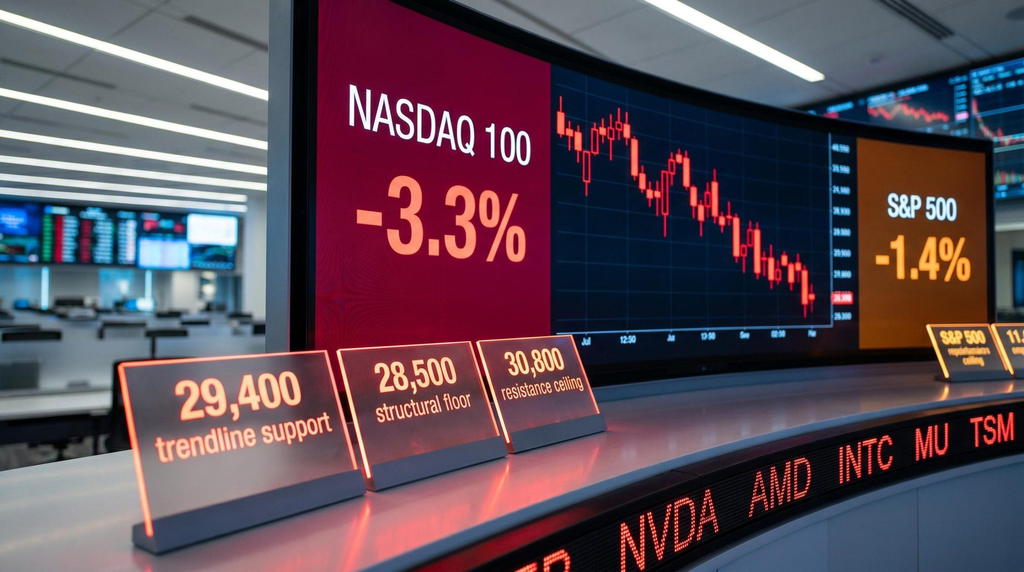
The technology-heavy Nasdaq Composite declined 1.25%, while the S&P 500 fell 0.47%. The Dow Jones Industrial Average moved against the broader market trend, gaining about 52 points.
The sell-off was concentrated in technology and semiconductor stocks as investors reassessed some of the companies most closely connected to the AI boom. Oracle shares fell more than 5%, while Nvidia and Advanced Micro Devices declined roughly 2% and 3%, respectively.
The weakness came as a report raised questions about OpenAI’s annualized revenue. At the same time, oil prices surged above $100 a barrel and Treasury yields remained elevated, creating a difficult environment for growth stocks.
The combination has left investors asking an important question: Has the AI trade become too expensive, or is Thursday’s decline simply a temporary reset after a powerful rally?
OpenAI Revenue Concerns Trigger AI Stock Sell-Off
The immediate catalyst for the technology sell-off was new information about OpenAI’s revenue.
Reports indicated that OpenAI’s annualized revenue was approaching $50 billion at the end of September, below the roughly $70 billion figure that had previously circulated in the market. A key part of the difference appears to involve how revenue is measured and whether revenue generated through cloud partners is included.

The distinction matters because investors have been using revenue figures to compare the rapidly growing AI companies and assess whether enormous spending on computing infrastructure can ultimately generate sufficient returns.
The market reaction was swift.
Oracle, which has significant business exposure to the AI infrastructure buildout and a major relationship with OpenAI, fell sharply. Semiconductor companies including Nvidia and AMD also came under pressure.
Reuters reported that semiconductor stocks were among the hardest-hit areas of the market as investors worried that higher interest rates could make the enormous capital spending required for AI infrastructure more difficult to justify.
The reaction demonstrates how interconnected the AI ecosystem has become.
AI model developers depend on computing infrastructure. Cloud companies provide that infrastructure, while chipmakers supply the processors required to train and operate increasingly sophisticated models.
As a result, concerns about one major AI company’s revenue can quickly spread across the broader technology sector.
Is the AI Investment Boom Losing Momentum?
Thursday’s decline does not necessarily mean the AI boom is ending.
OpenAI’s reported revenue still represents extraordinary growth, and demand for generative AI products continues to expand among businesses and consumers.
The bigger issue for investors is whether revenue growth will be large enough to justify the enormous investments being made in data centers, AI chips, networking equipment and cloud infrastructure.
This is an increasingly important question because AI infrastructure spending has reached unprecedented levels.
Companies are investing billions of dollars in data centers and computing capacity based on expectations that demand for AI services will continue increasing for years.
If that demand grows as expected, companies supplying the infrastructure could continue benefiting.
But if AI revenue growth slows significantly, investors may begin questioning whether the industry has overbuilt capacity.
That is why Thursday’s OpenAI-related news had an impact far beyond OpenAI itself.
Investors are increasingly moving from the first phase of the AI story — “How big will AI become?” — toward a more difficult question:
“How much revenue and profit will AI actually generate?”
AI Adoption Continues Across Finance and Business
Despite the market reaction, artificial intelligence continues to move deeper into corporate America.
For example, AI agents are increasingly being used to automate research, data collection and repetitive workflows.
FinovaInsights recently examined this development in its article on Agentic AI taking over Wall Street in 2026. The article explores how financial institutions are experimenting with AI agents to handle repetitive tasks while allowing analysts and bankers to focus more heavily on judgment and decision-making.
This broader adoption is important when considering the OpenAI revenue debate.
Even if one AI company experiences slower-than-expected revenue growth, that does not automatically mean businesses have lost interest in AI.
Companies may simply become more selective about which AI products they purchase and how much they are willing to spend.
The long-term opportunity therefore depends not only on model development but also on whether AI applications can deliver measurable productivity improvements.
AI’s Role in Financial Markets Is Expanding
The financial industry provides a useful example of how AI adoption is evolving.
Banks and investment firms are increasingly experimenting with AI for research, document analysis, market monitoring, customer service and other repetitive tasks.
At the same time, investors are using AI-powered tools to process enormous amounts of financial information.
FinovaInsights’ guide What Are AI Agents? How They Work and Why They Matter in 2026 explains the difference between traditional AI chatbots and AI agents that can plan tasks, use tools and execute multi-step workflows.
This distinction matters because the economic value of AI may ultimately come from systems that do more than generate text.
If AI agents can reliably complete tasks that previously required hours of human labor, businesses may be willing to spend substantially more on the technology.
That would create a stronger foundation for long-term AI revenue growth.
Oil Prices Add Another Problem for Stocks
The AI-related selling was only one part of Thursday’s market weakness.
Oil prices also jumped sharply as geopolitical tensions in the Middle East increased.
Brent crude rose more than 4% to around $104 per barrel, while West Texas Intermediate futures gained more than 3.6% to settle near $91.50 per barrel.
The increase in oil prices created fresh inflation concerns.
Higher energy prices can affect the economy through several channels.
Transportation becomes more expensive, businesses face higher operating costs and consumers may have less disposable income after paying more for gasoline and other energy-related expenses.
If businesses pass those costs to consumers, inflation can remain elevated for longer.
That creates a problem for the Federal Reserve.
If inflation remains high, policymakers may be less willing to cut interest rates and could potentially keep monetary policy restrictive for longer.
For technology stocks, that can be particularly painful.
Why Higher Oil Prices Matter for the Federal Reserve
The Federal Reserve has been attempting to balance economic growth against inflation.
Recent U.S. inflation data provided some relief, with August PCE inflation rising less than economists expected. The PCE price index increased 0.3% in August, while annual inflation reached 3.4%. Consumer spending, however, surged 0.9%.
FinovaInsights also covered those numbers in US Inflation Rises Less Than Expected in August 2026 as Consumer Spending Surges 0.9%.
The latest rise in oil prices complicates that picture.
Even if underlying inflation begins to moderate, a sustained energy shock could push headline inflation higher again.
Investors therefore have to consider two competing forces:
- AI investment is supporting economic growth and corporate spending.
- Higher energy prices could increase inflation.
- Higher inflation could keep interest rates elevated.
- Higher rates can pressure technology valuations.
- Slower AI revenue growth could further increase scrutiny of expensive technology stocks.
That combination explains why investors became more cautious Thursday.
Treasury Yields Remain a Major Risk for Technology Stocks
Another major factor weighing on equities is the bond market.
The benchmark 10-year Treasury yield was around 5.24%, while the 30-year yield was approximately 5.62%.
Those levels are important because Treasury yields influence borrowing costs throughout the economy.
When government bond yields rise, companies generally face higher financing costs.
Higher yields can also make bonds more attractive relative to stocks, particularly for investors looking for income.
The effect can be particularly significant for growth companies.
Many technology stocks are valued based on expectations of earnings far into the future. When interest rates rise, those future earnings become less valuable in today’s terms.
That can put downward pressure on high-growth companies even if their underlying businesses remain strong.
Higher-for-Longer Rates Could Become the New Normal
Investors are increasingly considering whether the era of extremely low interest rates is permanently behind them.
Baird investment strategist Ross Mayfield said inflation pressures, particularly those connected to energy prices, have influenced the outlook for interest rates.
He suggested that Treasury yields could potentially stabilize in the 5% to 6% range.
For investors, that would represent a very different environment from the ultra-low-rate period that helped fuel enormous valuations for technology and growth companies.
Higher yields do not necessarily mean the economy is weak.
They can also reflect stronger nominal economic growth and expectations for somewhat higher inflation.
The problem arises if yields continue climbing rapidly.
A substantial increase in long-term yields could make stocks less attractive, increase corporate borrowing costs and place additional pressure on technology valuations.
Strong Treasury Auction Provides Some Relief
There was at least some positive news from the bond market.
A strong auction of 30-year Treasury bonds helped push yields lower from their session highs.
The 10-year Treasury yield declined more than three basis points, while the 30-year yield fell about four basis points.
The move provided some relief to investors who have become increasingly concerned about the rapid increase in long-term borrowing costs.
However, one successful auction does not eliminate the broader issue.
Markets will continue watching Treasury demand, inflation expectations and Federal Reserve policy to determine where long-term yields are headed.
Palantir Moves Higher Despite Broad Tech Weakness
While many technology stocks declined, Palantir Technologies was one of the notable exceptions.
Palantir shares gained around 2% after Goldman Sachs upgraded the company.
The firm argued that Palantir could benefit from growing demand for sovereign AI and customized artificial intelligence applications.
The development highlights an important shift taking place within the AI industry.
Investors are no longer focused only on companies developing the largest AI models.
They are increasingly looking at businesses that can turn AI into practical products and services.
That includes companies involved in enterprise software, cybersecurity, cloud computing, data analytics and specialized AI applications.
The next phase of the AI market could therefore become more selective.
Companies that can demonstrate real customer demand and measurable financial benefits may receive greater investor support than businesses whose valuations depend primarily on future expectations.
The Global AI Race Adds Another Layer
The AI investment story is also becoming increasingly connected to geopolitical competition.
The United States and China are competing for leadership in AI research, computing infrastructure, chips and commercial applications.
FinovaInsights previously examined this issue in China vs. US AI Race 2026: Who’s Really Ahead?.
The competition matters for investors because AI infrastructure is not simply a technology story anymore.
It is also connected to national security, semiconductor supply chains, data centers and government investment.
Companies that control critical AI infrastructure could therefore remain strategically important even during periods of market volatility.
What the OpenAI Revenue Setback Means for Nvidia and Oracle
The market reaction to OpenAI’s revenue figures is particularly important for companies such as Nvidia and Oracle because both are closely associated with the AI infrastructure buildout.
Nvidia has become one of the most important suppliers of advanced computing hardware used to train and run AI models.
Oracle, meanwhile, has invested heavily in cloud infrastructure and has a significant relationship with OpenAI.
When investors question the growth trajectory of major AI model developers, they naturally begin asking whether infrastructure spending can continue at its current pace.
That does not mean Nvidia or Oracle will necessarily experience a long-term decline.
Instead, investors may demand stronger evidence that AI-related spending will generate sufficient returns.
The market is becoming more focused on return on investment, rather than simply AI adoption.
Is Thursday’s Sell-Off a Buying Opportunity?
That depends heavily on an investor’s time horizon and risk tolerance.
For long-term investors, a single session of market weakness does not necessarily change the underlying AI investment thesis.
AI adoption remains a major technological trend, and businesses continue investing in automation, cloud computing and AI applications.
However, investors should also recognize that strong technology companies can still experience significant declines when expectations become too high.
Thursday’s move is a reminder that even the strongest technology themes are not immune to valuation risk.
The combination of elevated Treasury yields, higher oil prices and questions about AI revenue growth could produce additional volatility.
Investors should therefore distinguish between a temporary market correction and a fundamental deterioration in AI demand.
Those are very different situations.
What Investors Should Watch Next
Several indicators will be particularly important in the coming weeks.
1. AI Company Revenue
Investors will want to see whether major AI companies can continue growing revenue at the pace necessary to justify current expectations.
2. Semiconductor Demand
Nvidia, AMD and other chipmakers will remain important indicators of whether companies are continuing to spend aggressively on AI infrastructure.
3. Oil Prices
A sustained move above $100 per barrel could create additional inflation pressure and complicate the Federal Reserve’s policy decisions.
4. Treasury Yields
The 10-year and 30-year Treasury yields will remain critical for technology valuations.
5. Federal Reserve Policy
Investors will closely monitor inflation, employment and economic growth data for clues about the future path of interest rates.
6. Enterprise AI Spending
Perhaps most importantly, investors will want evidence that businesses are not merely experimenting with AI but are actually paying for products that deliver measurable value.
AI Is Still a Major Opportunity — But Expectations Are Changing
The latest market decline should not automatically be interpreted as the end of the AI boom.
Instead, it may represent a transition to a more mature stage of the investment cycle.
Early in the AI boom, investors were primarily focused on the technology’s potential.
Now they increasingly want proof.
They want to know how many customers are paying for AI, how much revenue those customers generate, how profitable the services are and whether the enormous cost of computing infrastructure can eventually produce attractive returns.
That is a healthier question for the industry.
AI does not need to collapse for valuations to become more realistic.
Likewise, a company can remain a major AI leader while its stock price declines if investor expectations had simply become too aggressive.
Conclusion: The AI Boom Isn’t Over, But Investors Are Becoming More Selective
Thursday’s Nasdaq decline reflects a combination of concerns rather than a single problem.
OpenAI’s reported revenue figure raised questions about the pace of AI monetization. Rising oil prices increased inflation concerns. Elevated Treasury yields created additional pressure on technology valuations.
Together, these factors produced a difficult environment for AI-related stocks.
However, the underlying AI story remains significant.
Businesses continue investing in artificial intelligence, AI agents are expanding into finance and enterprise workflows, and governments are treating AI infrastructure as strategically important.
The key difference is that investors are now demanding more evidence that those investments will translate into sustainable revenue and profits.
The AI boom may not be over, but the market is becoming much less willing to pay any price for AI growth.
For investors, that could mean the next phase of the AI trade will be less about owning every company associated with artificial intelligence and more about identifying businesses with strong fundamentals, real customer demand and a credible path to long-term profitability.
Source: Market information and reporting referenced from Reuters and other financial-market reporting. This article is for informational and educational purposes only and should not be considered personalized investment advice.