

US inflation rose 3.4% year over year in August 2026, below expectations, while consumer spending surged 0.9%. Find out what the latest data means for Federal Reserve interest rates and the US economy.
US Inflation Rises Less Than Expected in August 2026 as Consumer Spending Surges 0.9%
Introduction
US inflation increased less than economists expected in August 2026, while consumer spending recorded a sharp rise, according to US Commerce Department data reported by Reuters on September 30. The figures suggest price pressures may be moderating. Strong consumer demand, however, continues to challenge policymakers.
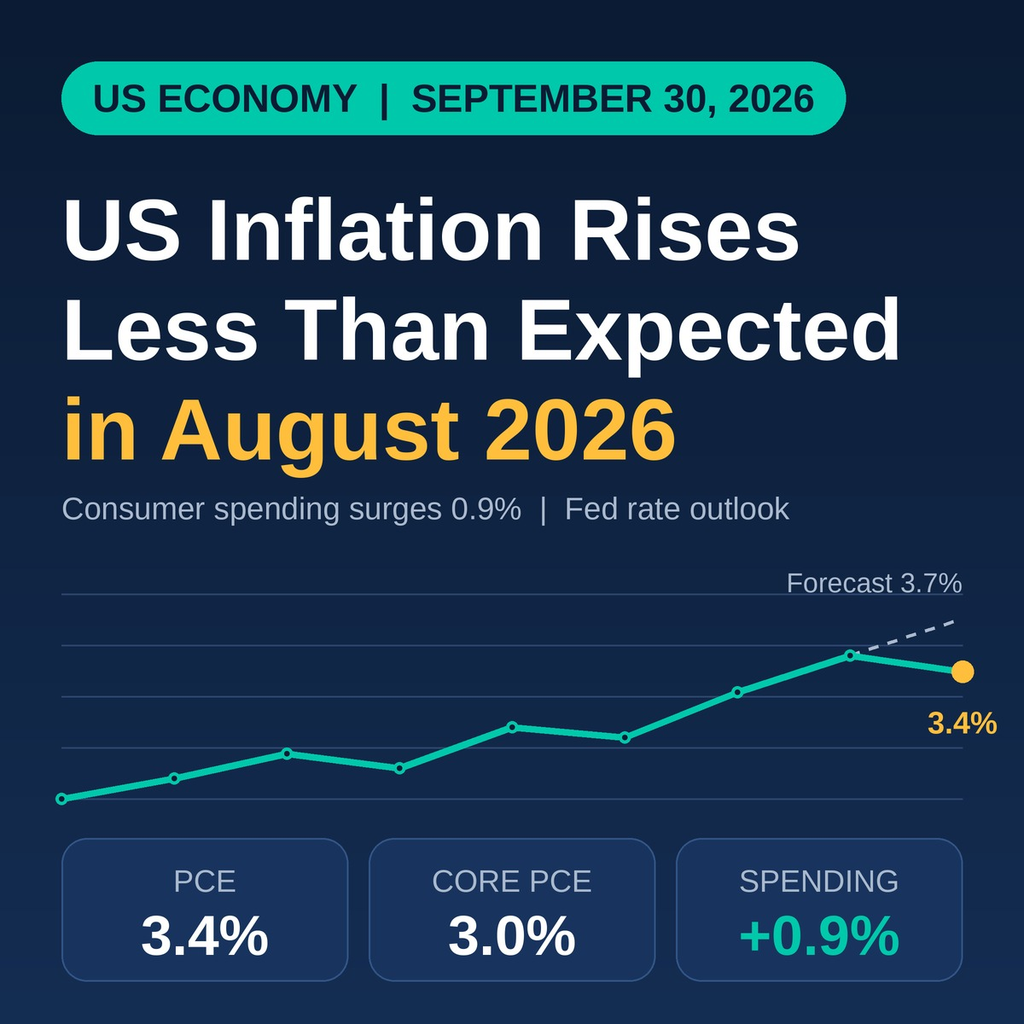
The Personal Consumption Expenditures (PCE) Price Index, the Federal Reserve’s preferred inflation measure, rose 0.3% in August from the previous month. On a year-over-year basis, inflation stood at 3.4%.
Consumer spending surged 0.9%. American households kept supporting economic activity despite elevated prices and high borrowing costs.
The combination of softer inflation and resilient spending could shape the Fed’s next move. The central bank raised its benchmark rate to the 3.75%–4.00% range earlier this month, its first hike in three years, and signaled that more increases could follow. Inflation remains above the 2% target, so the direction of policy in the coming months is still uncertain.
US Inflation Data for August 2026: Key Highlights
The report contains several important indicators of how the US economy is performing:
- Headline PCE inflation: up 0.3% month over month
- Annual PCE inflation: 3.4% compared with August 2025
- Core PCE inflation: up 0.2% during the month
- Annual core PCE inflation: 3.0%
- Consumer spending: up 0.9% in August
- Real consumer spending: up 0.6% after adjusting for inflation
- US GDP growth: second-quarter growth revised up to an annualized 2.2%
The US economy kept expanding even as households faced persistent price pressures. The inflation data also gave some relief to financial markets worried about more interest-rate increases.
1. US Inflation Rises 3.4% Annually
The PCE Price Index rose 0.3% in August, following a revised 0.1% increase in July. Economists surveyed by Reuters had expected a 0.4% rise for August.
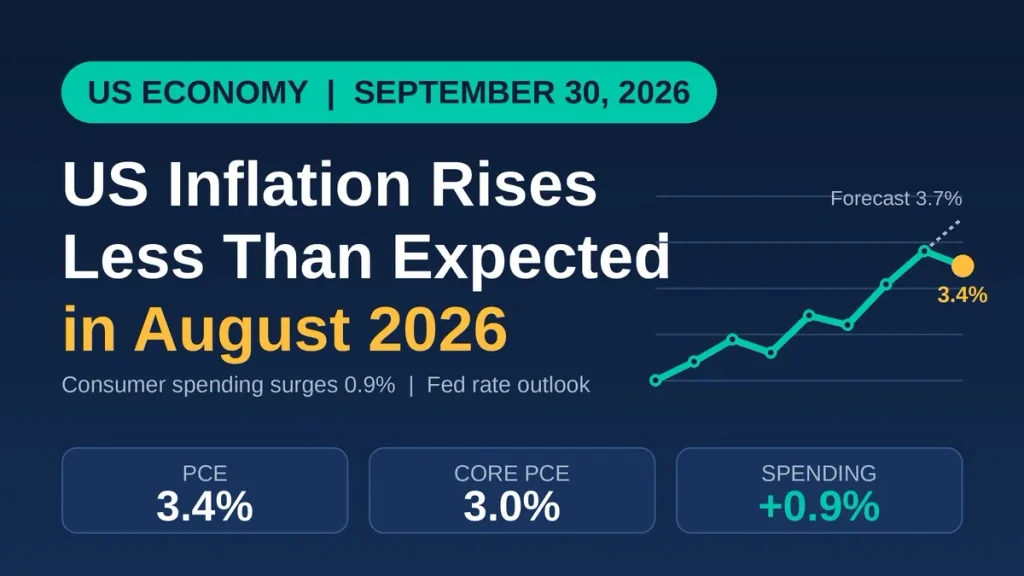
Annual PCE inflation reached 3.4%, unchanged from the revised July reading. Economists had forecast an annual rate of about 3.7%, so the reading came in well below expectations.
The Bureau of Economic Analysis (BEA) also revised historical inflation data. According to Reuters, the BEA changed its methodology for pricing software and accessories, portfolio management fees and legal services. Revisions like these are why investors and policymakers pay attention to the changes as well as the headline release.
A 3.4% annual rate still means prices are rising much faster than the Fed’s long-term target. August was softer than feared, but inflation is not yet back under control.
2. Core PCE Inflation Reaches 3.0%
Core PCE inflation excludes food and energy prices and rose 0.2% in August. The annual core rate stood at 3.0%.
Economists and policymakers watch the core measure because food and energy prices can swing sharply over short periods. It gives a clearer view of whether inflationary pressure is becoming entrenched or gradually easing.
Underlying inflation remains above the Fed’s 2% target. The central bank has to work out whether the recent moderation will continue or whether strong demand, energy costs and other pressures will keep inflation elevated.
One month of data cannot establish a lasting trend. Future inflation reports will show whether price increases keep moderating.
3. Consumer Spending Surges 0.9% in August
Consumer spending was one of the strongest parts of the report. Personal consumption expenditures rose 0.9% in August, following a downwardly revised 0.1% gain in July. After adjusting for inflation, spending rose 0.6%.
Consumer spending accounts for more than two-thirds of US economic activity, which makes it a crucial gauge of economic health. The increase suggests households kept spending despite high inflation and borrowing costs, and strong spending can support businesses, employment and growth.
Rising expenditure does not mean every household is financially comfortable. Prices, income, savings and access to financial assets affect households differently.
Personal income rose 0.2% in August and disposable income rose 0.3%. After adjusting for inflation, disposable income was unchanged. That gap between nominal income and real income explains why higher spending does not automatically mean greater purchasing power.
4. Will the Federal Reserve Raise Interest Rates Again?
The report could give the Fed more time to assess conditions before its next decision. According to Reuters, financial markets cut their expectations of an October rate increase after the data.
CME’s FedWatch tool showed a 65.1% chance the Fed would hold rates steady at its October meeting and a 34.9% chance of another 25-basis-point hike. Earlier in the week a hike had been the more likely outcome. Comments from New York Fed President John Williams on Tuesday, in which he saw “no urgency” for further action, had already reduced the odds. These figures are market expectations at the time of the report, not a prediction of the Fed’s decision. Different trackers show slightly different probabilities.
The Fed faces two competing considerations.
Factors that could support a pause:
- Inflation rose less than economists expected
- Revised data showed more moderate price growth in July
- Core PCE inflation held at 3.0% annually rather than accelerating
Factors that could support further tightening:
- Headline inflation remains well above the 2% target
- Consumer spending rose strongly
- Higher energy prices could add to inflationary pressure
- Economic activity continues to show resilience
BMO Capital Markets economist Sal Guatieri said the softer price data may buy the Fed time to wait for more data and pass on October 28, but that elevated inflation and a resilient economy still point to another hike by year-end.
The Fed will weigh these indicators alongside employment conditions, inflation expectations and incoming data. The August report alone does not settle whether rates will rise, hold or move in another direction at the next meeting.
5. US Economic Growth Remains Resilient
The Reuters report also highlighted an upward revision to second-quarter GDP growth. The economy expanded at an annualized 2.2% in the April–June quarter.
Business investment contributed, particularly spending on artificial intelligence infrastructure. Business spending on equipment also posted another quarter of double-digit growth, according to the report. That investment supports demand for computing equipment, data centers, networking systems and related services.
Consumer spending helped sustain activity too. Strong growth can complicate the Fed’s efforts to bring inflation back to target, though. If demand stays strong while supply or production costs are constrained, price pressures may persist. The balance between growth and inflation will stay central for policymakers and investors.
6. Falling Savings Rate Raises Questions About Household Finances
The personal saving rate fell to 4.1% in August from a revised 4.6% in July. Households saved a smaller share of disposable income during the month.
Spending can stay strong when households draw on accumulated savings or benefit from gains in financial assets. The Reuters report noted that AI-related stock market gains and household savings were among the factors supporting spending. It also said annual revisions showed households had more savings than previously estimated.
The aggregate saving rate does not tell the whole story. Higher-income households tend to have more financial assets, while lower-income households often depend on current earnings for everyday expenses. Inflation, employment, rent, food costs and borrowing rates therefore affect income groups differently.
Future data on wages, real disposable income, consumer confidence and spending will help show how sustainable the recent increase in consumption is.
7. What Does the Inflation Report Mean for Investors?
Inflation figures affect financial markets through expectations about Fed policy. According to Reuters, US stocks rose after the release, the dollar weakened against a basket of currencies, and Treasury yields declined. The US dollar index fell about 0.28% to 101.10.
These moves are consistent with markets reassessing the chance of more monetary tightening. Markets respond to many factors, though, and one report does not explain every price movement. Some strategists also cautioned that the data is a month old and does not yet reflect recent energy price pressure.
Investors may want to monitor the following:
- Inflation reports: whether price pressures keep moderating
- Federal Reserve communications: how policymakers assess inflation and growth
- Employment data: labor-market strength and wage pressure
- Consumer spending and confidence: whether household demand stays resilient
- Energy prices: potential changes in transportation and production costs
- Treasury yields and market expectations: how financial conditions react to new data
For investors, the key question is not whether inflation falls in a single month. It is whether inflation is moving sustainably toward the Fed’s target without a significant deterioration in economic activity.
8. What Could Happen Next to US Inflation?
The outlook depends on how several forces develop.
If inflation keeps moderating while employment and consumer demand stay stable, the Fed may have more flexibility in choosing its next steps.
If consumer spending stays strong and energy costs keep rising, inflation could prove more persistent than the latest monthly figures suggest.
If borrowing costs and living expenses weigh more heavily on households and businesses, demand could weaken.
These scenarios are possibilities, not established outcomes. The direction of inflation, interest rates and growth will depend on incoming data and the Fed’s overall assessment. For now, the August report is mixed: inflation was lower than expected, but spending remained strong and annual price increases continued to exceed the Fed’s target.
Conclusion
US inflation rose less than expected in August 2026. The PCE Price Index increased 0.3% during the month and 3.4% over the year, core PCE inflation stood at 3.0% annually, and consumer spending surged 0.9%.
The data prompted markets to reduce expectations of an October Fed rate increase. Above-target inflation, strong consumer demand and elevated energy prices still leave monetary policy uncertain. The next inflation, employment and spending reports will help show whether the recent moderation is a lasting improvement or a temporary change.
For households, businesses and investors, the central question is whether the US economy can keep its momentum while inflation gradually moves toward the Fed’s 2% target.
Sources:
- CNBC, September 30, 2026
- Fox Business, August 2026 PCE report
- ADM Investor Services, August PCE commentary
- US Bureau of Economic Analysis
Disclaimer: This article is for informational and educational purposes only. It does not constitute investment, financial or tax advice. Economic figures and market expectations reflect the cited reports and may be revised.