

Vice President JD Vance has accused Microsoft of replacing American workers with foreign hires following thousands of layoffs. But U.S. visa data reveals a more complicated picture, with many H-1B approvals going to existing employees and other major technology companies receiving even more approvals.
Vance Says Microsoft Replaced Laid-Off Workers With Foreign Hires: What the Visa Data Shows
Vice President JD Vance has accused Microsoft of replacing American workers with foreign hires following thousands of layoffs. But U.S. visa data reveals a more complicated picture, with many H-1B approvals going to existing employees and other major technology companies receiving even more approvals.
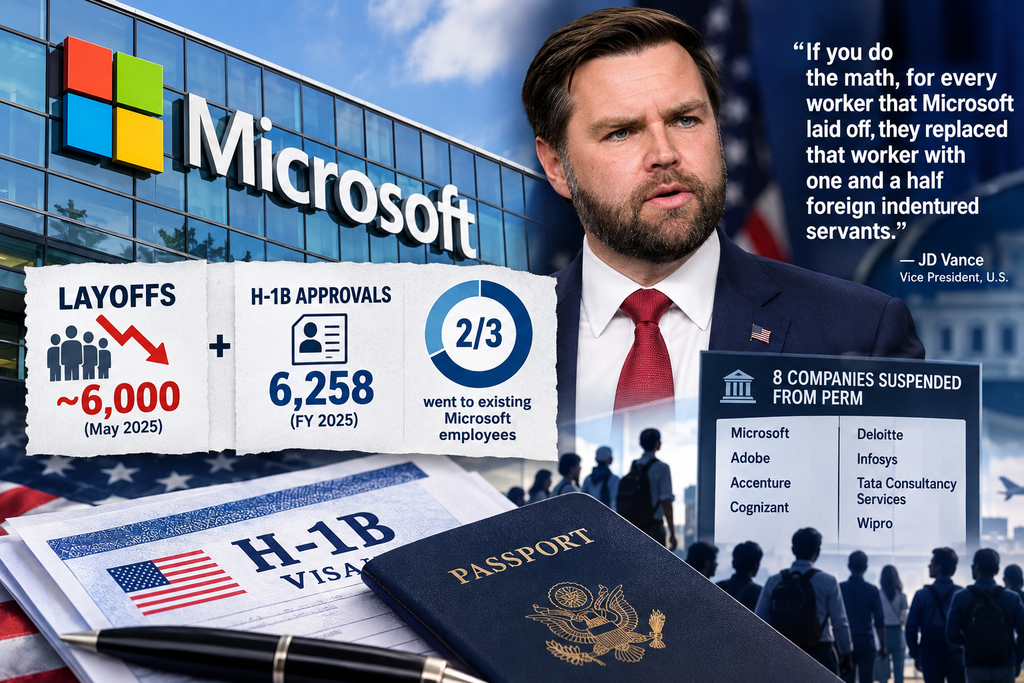
The Trump administration’s decision to suspend eight technology companies from sponsoring foreign workers for employment-based green cards has reignited the debate over immigration, technology jobs, and the protection of American workers.
Microsoft became a central focus of that debate after Vice President JD Vance claimed that the company laid off approximately 6,000 American workers in 2025 while receiving more than 6,000 H-1B visa approvals.
However, the figures require closer examination. H-1B approvals do not necessarily represent newly hired foreign workers, and the PERM program targeted by the administration is different from the H-1B temporary work visa program.
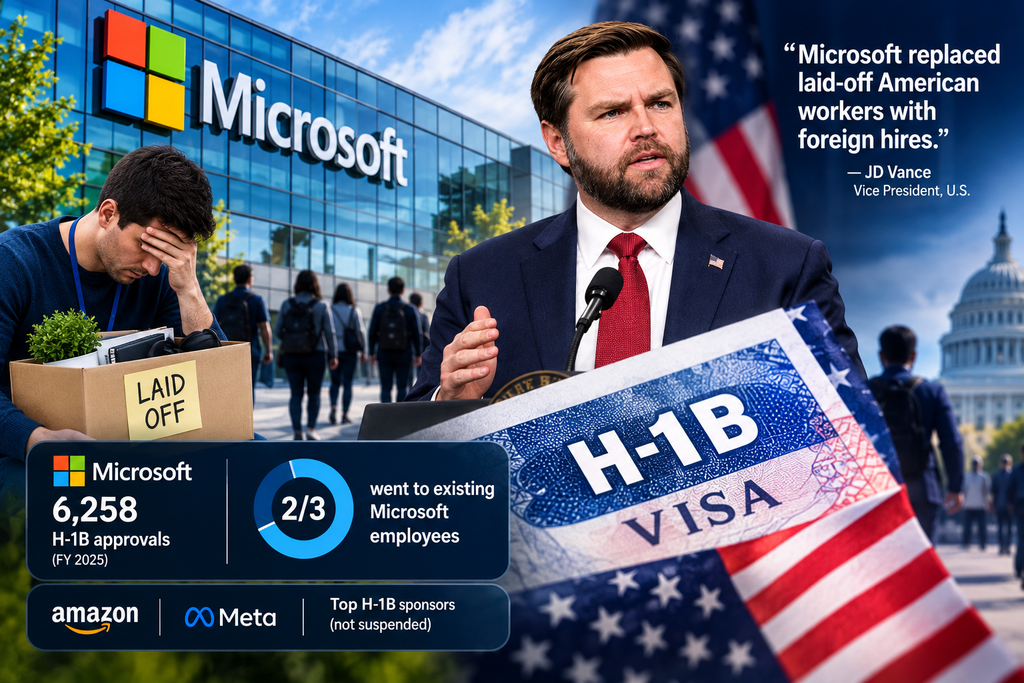
Data from U.S. Citizenship and Immigration Services (USCIS) shows that Microsoft received 6,258 H-1B approvals in fiscal year 2025. Approximately two-thirds of those approvals reportedly went to people already working at the company.
The figures raise important questions about how technology companies hire international talent, how layoffs should be compared with visa approvals, and whether the administration’s enforcement measures are being applied consistently across the industry.
Why Did the Trump Administration Suspend Eight Technology Companies?
On October 8, 2026, the Trump administration announced the suspension of eight technology companies from participating in the Department of Labor’s PERM labor-certification process.
PERM is an important step in many employer-sponsored employment-based green-card applications. It generally requires employers to demonstrate that there are insufficient qualified, available U.S. workers for the position and that employing the foreign worker will not adversely affect the wages and working conditions of similarly employed U.S. workers.
The administration’s action was presented as part of a broader effort to investigate alleged abuse of employment-based immigration programs.
Most of the companies on the suspension list operate in IT services and consulting, industries that frequently employ international technology professionals.
Important distinction: A suspension from PERM participation is not the same as a blanket suspension of H-1B visas. The two programs serve different purposes, and the reported action does not, by itself, mean that every affected company’s existing H-1B employee must leave the United States.
What Did JD Vance Say About Microsoft?
Vance singled out Microsoft during the administration’s announcement, arguing that the company’s layoffs and H-1B visa approvals demonstrated that foreign workers were being brought in while American employees lost their jobs.
His argument was based on comparing Microsoft’s reported 2025 layoffs with the number of H-1B approvals recorded for the company.
The comparison has attracted attention because Microsoft is one of the largest employers in the U.S. technology sector and a major sponsor of employment-based visas.
However, the two figures measure different things. Layoff announcements count jobs eliminated during a particular period, while visa approvals may include employees already working for the company, people changing employers, and other cases that do not necessarily correspond to new positions created after layoffs.
Consequently, the numbers alone do not establish that Microsoft replaced each laid-off American worker with a foreign worker.
Microsoft Layoffs vs. H-1B Visa Approvals: The Numbers
The available figures show that Microsoft carried out multiple rounds of layoffs in 2025 while receiving thousands of H-1B approvals.
| Metric | Reported figure | What it means |
| Microsoft layoffs announced in May 2025 | About 6,000 | Worldwide job cuts |
| Additional layoffs announced in July 2025 | About 9,000 | A further round of job reductions |
| Washington state layoff notices filed in 2025 | 3,202 workers | Notices covering qualifying layoffs in Washington |
| California layoff notices tracked in 2025 | About 94 | Reported notices; scope and coverage differ from nationwide totals |
| Microsoft H-1B approvals, FY2025 | 6,258 | USCIS employer approval figure |
| Microsoft employees in the United States | About 125,000 | Approximate figure cited from company reporting |
Sources: Microsoft announcements and company reporting; Washington Employment Security Department WARN records; California WARN tracking; USCIS H-1B Employer Data Hub. Figures cover different geographic areas, periods, and measurement categories.
Microsoft announced approximately 6,000 job cuts in May 2025. It later announced another round of reductions affecting approximately 9,000 positions in July.
These figures should not be treated as a single count of American workers replaced by foreign hires. The announcements included worldwide workforce reductions, whereas U.S. visa approvals and state layoff notices have different geographic and administrative scopes.
Washington state records covering 3,202 workers also do not represent Microsoft’s complete nationwide layoff total. State WARN notices apply under specific legal reporting requirements and do not capture every job reduction.
The central issue is therefore not simply whether layoffs and visa approvals occurred in the same year. It is whether the approved visas corresponded to new hires replacing particular U.S. employees. The aggregate figures cannot answer that question on their own.
What Does the H-1B Data Actually Show?
USCIS employer data provides a more detailed picture of which technology companies receive H-1B approvals.
For Microsoft, the reported total of 6,258 approvals in fiscal year 2025 places the company among the largest H-1B sponsors in the country.
Yet the composition of those approvals matters.
According to the reported analysis, approximately two-thirds of Microsoft’s approvals went to people who were already employed by the company. Such cases may involve extensions or other continuing employment situations rather than a completely new employee joining the company.
This distinction matters because an H-1B approval count is not a direct measure of new foreign recruitment. Nor does it show whether an individual visa holder filled a position previously occupied by a U.S. worker.
The data provides evidence of substantial use of the H-1B program, but it does not independently establish that Microsoft’s layoffs were directly linked to foreign hiring.
Microsoft vs. Amazon vs. Meta: H-1B Approvals in 2025
The comparison becomes more interesting when Microsoft’s figures are placed alongside those of Amazon and Meta.
| Company | H-1B approvals in FY2025 | Position in the reported comparison | Included in the eight-company PERM suspension? |
| Amazon | 19,178 | No. 1 | No |
| Meta | 6,294 | No. 2 | No |
| Microsoft | 6,258 | No. 3 | Yes |
| Adobe | Among the top 50 sponsors; reported at No. 45 | No. 45 | Yes |
Source: USCIS H-1B Employer Data Hub and the October 8, 2026, report on the administration’s suspension action. Rankings and approval counts refer to the reported fiscal-year comparison.
Amazon recorded 19,178 H-1B approvals, substantially more than Microsoft’s 6,258. Meta recorded 6,294, slightly more than Microsoft.
Neither Amazon nor Meta was included in the reported PERM suspension list.
This does not automatically establish that the administration acted inconsistently or that the companies should have received the same treatment. PERM suspensions may depend on factors beyond a company’s total H-1B approvals, including the specific allegations or enforcement grounds involved.
Nevertheless, the comparison highlights why visa totals alone cannot establish whether a company has violated labor or immigration rules.
Why Is Amazon’s Position Important?
Amazon’s higher approval count demonstrates that Microsoft is not the only major technology employer relying heavily on the H-1B system.
But the number of approvals does not, by itself, establish how many new employees Amazon recruited. A fair comparison requires distinguishing new employment from continuing employment, examining job categories, and considering the reasons behind the government’s enforcement decisions.
The same standards should apply to Microsoft, Amazon, Meta, and other large employers.
What Is the Difference Between H-1B Visas and PERM Green Cards?
One of the most important parts of this debate is understanding that H-1B and PERM are not interchangeable immigration programs.
| Feature | H-1B visa | PERM labor certification |
| Main purpose | Allows qualifying employers to employ eligible foreign professionals in specialty occupations | Helps establish labor-market eligibility for many employer-sponsored permanent employment cases |
| Immigration status | Temporary, nonimmigrant status | A step in a potential employment-based permanent-residency process |
| Government agency | U.S. Citizenship and Immigration Services (USCIS), with other agencies involved in the broader program | U.S. Department of Labor |
| Typical role | Employment authorization under H-1B requirements | Labor-market certification for qualifying green-card cases |
| Does it automatically grant a green card? | No | No |
| Does a PERM suspension automatically cancel existing H-1B status? | No | No |
The distinction is crucial.
An employer may sponsor a worker for an H-1B visa and separately pursue permanent residency through an employment-based immigration process. These processes have different eligibility rules and requirements.
Suspending a company’s access to PERM does not automatically cancel its H-1B approvals or revoke the status of every foreign employee working there.
Likewise, a high number of H-1B approvals does not prove that an employer has improperly replaced American workers.
Does H-1B Hiring Mean American Workers Are Being Replaced?
The answer depends on the circumstances.
Technology companies hire internationally for several reasons, including demand for specialized technical skills, global recruitment, and the need to fill particular roles.
Critics argue that some employers may use employment-based immigration programs in ways that put downward pressure on wages or disadvantage domestic workers. Supporters argue that international recruitment can help companies fill specialized positions, expand operations, and remain competitive.
Both discussions require evidence rather than assumptions based only on headline totals.
To establish that a company replaced laid-off U.S. workers with foreign hires, investigators would need more specific information, such as:
- Whether the foreign hires filled the same roles as the employees who were laid off.
- Whether the jobs were located in the same country, office, or business unit.
- Whether the foreign workers were new hires or existing employees receiving continued authorization.
- Whether the positions involved comparable responsibilities, skills, and wages.
- Whether the employer complied with applicable immigration and labor requirements.
Without such evidence, a comparison between total layoffs and total visa approvals cannot demonstrate direct worker-for-worker replacement.
Why Were IT Services Companies Targeted?
Most of the eight companies reportedly suspended from the PERM program are IT services and consulting firms.
These businesses frequently provide technology services to clients and recruit workers with specialized skills across multiple locations. Their employment and immigration arrangements can differ from those of technology companies that primarily develop and sell their own products.
Adobe, which was reported at No. 45 among H-1B sponsors in the comparison, was the smallest company on the suspension list by that ranking.
However, the companies’ position in an H-1B ranking should not be confused with the government’s reasons for suspending them. The exact enforcement grounds and any supporting findings must be assessed independently.
The action also shows that the administration’s scrutiny extends beyond individual technology giants to the wider employment-based immigration system.
The Investigation Into Alleged University Visa Fraud
The administration’s October 8 announcement also included an investigation into alleged J-1 visa fraud involving nine major American universities, according to the reported remarks by Labor Department Inspector General Anthony D’Esposito.
The J-1 program is different from both H-1B visas and PERM. It supports authorized exchange visitor programs, including academic, research, and other qualifying exchange activities.
The announcement adds another dimension to the administration’s broader focus on immigration-program oversight.
However, an announced investigation is not the same as a final finding of wrongdoing. Any conclusions about individual institutions should depend on the evidence and the outcome of the relevant investigations.
What the Visa Data Means for U.S. Technology Workers
The Microsoft controversy illustrates a wider challenge for policymakers: how to balance domestic employment opportunities with businesses’ demand for specialized talent.
Layoffs can occur because of restructuring, changing business priorities, cost reductions, automation, or shifts in demand. International hiring can take place at the same time, sometimes in different teams, locations, or areas of expertise.
That overlap deserves scrutiny, but it does not automatically prove that one caused the other.
For U.S. workers, the most useful information would include job-level hiring and layoff data, wage comparisons, employer compliance records, and evidence showing whether foreign recruitment directly displaced qualified domestic workers.
For technology employers, transparent hiring practices and compliance with immigration and labor rules remain essential.
For policymakers, enforcement decisions are more informative when the government clearly explains the legal grounds, supporting evidence, and standards applied across employers.
What Happens Next?
The reported PERM suspensions and related investigations could increase scrutiny of employer-sponsored immigration programs.
The practical impact will depend on the precise scope of the restrictions, their duration, the legal grounds for the action, and any subsequent administrative or judicial developments.
Affected companies may face disruption to their employment-based green-card processes. But the effect on individual workers will depend on their immigration category and circumstances; the reported suspension should not be interpreted as automatically ending every affected worker’s ability to remain employed in the United States.
The broader debate over H-1B visas is also likely to continue as policymakers weigh domestic job protection, business competitiveness, wages, and access to specialized skills.
Final Takeaway
The available figures confirm that Microsoft was a major H-1B sponsor in fiscal year 2025 while carrying out substantial layoffs. They also show that approximately two-thirds of Microsoft’s reported H-1B approvals went to people already working at the company.
Amazon and Meta received more H-1B approvals than Microsoft in the reported comparison, yet neither appeared on the eight-company PERM suspension list.
These figures raise legitimate questions about how companies use employment-based immigration programs. However, they do not independently prove that Microsoft replaced each laid-off American worker with a foreign hire.
The key distinction is between evidence of layoffs and visa sponsorship, and evidence that one directly replaced the other. Determining whether unlawful displacement occurred requires more detailed information than aggregate approval and layoff totals can provide.
Disclaimer: This article is for informational purposes only. It summarizes reported developments and publicly described data and does not constitute legal, immigration, or investment advice.
Sources and Further Reading
- CNBC — Report on the October 8, 2026, PERM suspension announcement: https://www.cnbc.com/2026/10/08/microsoft-adobe-green-card-labor-suspension.html
- CNBC — Microsoft’s 2025 workforce reductions: https://www.cnbc.com/2025/05/13/microsoft-is-cutting-3percent-of-workers-across-the-software-company.html
- USCIS — H-1B Employer Data Hub: https://www.uscis.gov/tools/reports-and-studies/h-1b-employer-data-hub
- U.S. Department of Labor — Permanent labor certification (PERM): https://www.dol.gov/agencies/eta/foreign-labor/programs/permanent
- USCIS — H-1B specialty occupations: https://www.uscis.gov/working-in-the-united-states/h-1b-specialty-occupations
Related reading on FinovaInsights: