

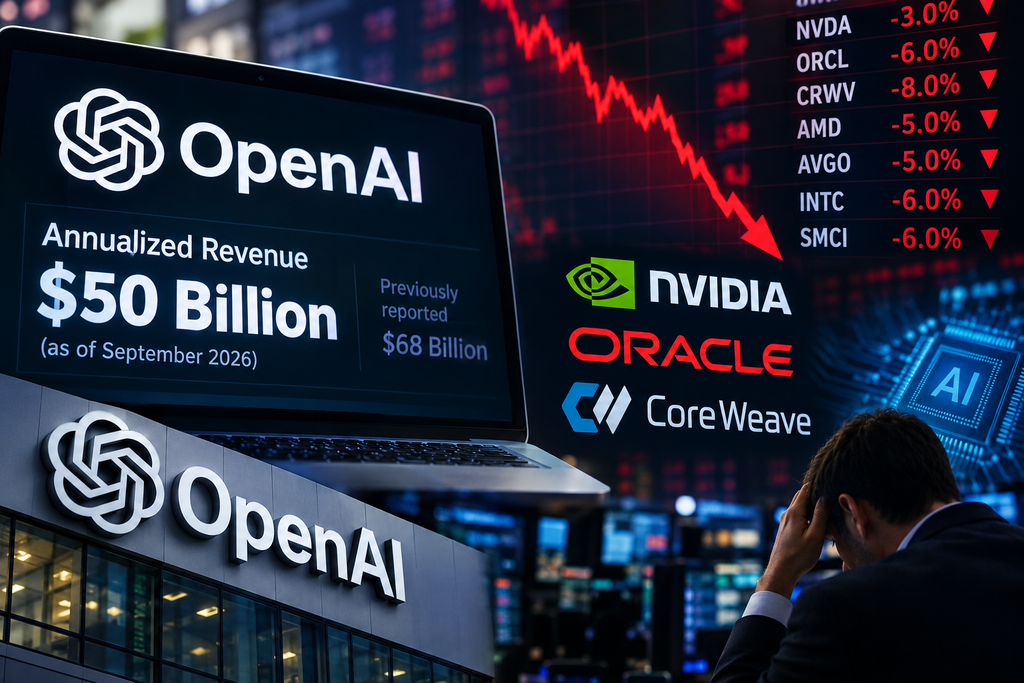
Nvidia, Oracle and CoreWeave shares fell after OpenAI’s reported $50 billion annualized revenue figure raised questions about AI valuations and growth.
Nvidia, Oracle, CoreWeave and Other AI Stocks Sink After OpenAI Revenue Report
AI stocks fell sharply after new details about OpenAI’s revenue raised questions about the growth expectations driving the artificial intelligence boom. Nvidia, Oracle, CoreWeave, AMD, Broadcom, Intel and Super Micro Computer were among the companies hit during Thursday’s trading session.
The artificial intelligence trade faced a fresh test on Wall Street after investors learned more about OpenAI’s financial performance.
OpenAI reportedly told investors that its annualized revenue had reached approximately $50 billion at the end of September 2026, according to reports from CNBC and other financial news outlets. That was below the roughly $68 billion figure previously circulated, with other reports describing the earlier estimate as approaching $70 billion.
The difference triggered concerns across the AI sector because OpenAI has become one of the most important companies in the global AI investment boom.
However, the discrepancy appears to be connected partly to how revenue is calculated, particularly the treatment of sales through cloud-computing partners. This distinction is important when comparing OpenAI with its competitor Anthropic.
The market reaction highlights a growing concern among investors: Can the enormous investments being made in artificial intelligence eventually generate enough revenue and profits to justify current valuations?
AI Stocks Fall as OpenAI Revenue Figures Draw Attention
Several leading technology and semiconductor stocks declined during Thursday’s trading session following the revenue report.
According to the supplied CNBC report, the intraday losses included:
- Nvidia (NVDA): down approximately 3%
- Oracle (ORCL): down approximately 6%
- CoreWeave (CRWV): down approximately 8%
- Advanced Micro Devices (AMD): down approximately 5%
- Broadcom (AVGO): down approximately 5%
- Intel (INTC): down approximately 6%
- Super Micro Computer (SMCI): down approximately 6%
These companies operate in different parts of the technology industry, but they share an important connection: their growth prospects are closely linked to demand for AI computing, data centers, chips, networking equipment and cloud infrastructure.
When investors become concerned about the future growth of a major AI developer, those concerns can spread to the companies supplying the technology needed to operate its AI systems.
That does not necessarily mean demand for AI is falling. Instead, investors may be reassessing whether the expected pace of growth is sufficient to support the prices they have been willing to pay for AI-related stocks.
Why OpenAI’s $50 Billion Revenue Figure Matters
The reported revenue figure attracted attention because it was lower than the number investors had previously been discussing.
OpenAI reportedly presented investors with an annualized revenue figure of approximately $50 billion for the end of September. The earlier $68 billion figure reportedly included gross revenue associated with the company’s partners.
A person familiar with the investor presentation said the distinction helped make OpenAI’s revenue more directly comparable with Anthropic’s figures.
This is an important difference because technology companies can calculate and report revenue-related metrics differently, particularly when their products are distributed through third-party platforms.
For investors, understanding what is included in a revenue figure is just as important as understanding its headline value.
OpenAI’s reported $50 billion annualized figure still points to a large business. The concern is whether investors had built their expectations around a higher number and whether those expectations were realistic.
The distinction also highlights a limitation of annualized revenue figures. They are often calculated by taking revenue over a shorter period and projecting it across a full year. Such calculations can help illustrate growth, but they are not the same as audited annual revenue and do not guarantee that the company will actually generate that amount over the next 12 months.
For a company operating in a rapidly changing market, that difference matters.
Nvidia Faces Fresh Questions About the AI Investment Boom
Nvidia has been one of the biggest beneficiaries of the rapid expansion of artificial intelligence.
Its graphics processing units, or GPUs, are widely used to train and run advanced AI models. As businesses invest in generative AI, data centers and large-scale computing systems, demand for Nvidia’s technology has become a major part of the AI infrastructure story.
But Nvidia’s outlook is also connected to the spending decisions of major AI developers and cloud-computing companies.
When companies expand their AI operations, they may need additional GPUs, networking equipment and data-center capacity. This can support demand across the semiconductor industry.
However, if investors begin to question how quickly AI companies can generate revenue from their products, they may also reconsider the pace of future infrastructure spending.
That is why a report about OpenAI’s revenue can influence Nvidia shares even though the two companies operate different businesses.
The important question is not simply whether AI companies continue to use GPUs. It is whether the growth in AI demand will be strong enough to support the infrastructure investment expected by the market.
Read more on FinovaInsights: China vs US AI Race 2026: Who’s Really Ahead?
This article explores the competition shaping AI development and the importance of computing infrastructure in the global technology race.
Why Oracle and CoreWeave Were Also Under Pressure
Nvidia is not the only company exposed to changes in AI spending expectations.
Oracle has expanded its cloud infrastructure business, positioning itself to benefit from demand for computing power and AI-related workloads. CoreWeave, meanwhile, provides specialized cloud infrastructure designed to support demanding computing tasks, including AI development.
These businesses can benefit when customers need more capacity to train, deploy and operate AI models.
However, infrastructure expansion can require substantial investment in data centers, equipment, energy and financing.
That creates a different risk profile from the one faced by software businesses that can expand without making comparable investments in physical infrastructure.
For infrastructure providers, investors must consider several factors:
- How quickly computing capacity is being deployed.
- Whether customers are committing to long-term contracts.
- How much capital is required to expand operations.
- Whether revenue can cover operating expenses, financing costs and infrastructure investment.
- Whether demand remains strong enough to support future expansion.
The OpenAI revenue report does not establish that these companies will experience lower demand. It does, however, illustrate how sensitive their valuations can be to changes in expectations surrounding major AI customers.
When large amounts of capital are committed before the full financial returns become clear, even a change in investor expectations can lead to substantial stock-price volatility.
OpenAI vs Anthropic: Why Revenue Comparisons Are Complicated
The competition between OpenAI and Anthropic has become an important part of the AI industry’s financial story.
Both companies develop advanced AI models and compete for enterprise customers, developers and consumer adoption. Both also require significant computing resources to develop and operate their products.
Anthropic reportedly told investors that its annualized revenue run rate reached approximately $65 billion at the end of July 2026.
However, revenue figures from the two companies are not necessarily calculated on an identical basis.
According to Reuters, OpenAI excludes certain revenue from sales through cloud partners such as Amazon Web Services and Google Cloud from the relevant figure, while Anthropic’s reported figures include sales through cloud partners. The treatment of these transactions helps explain why the two headline numbers are not directly comparable.
This distinction is important because cloud partners play a significant role in distributing AI products and providing the computing infrastructure required to operate them.
A meaningful comparison between AI companies should consider more than annualized revenue. Investors also need to understand revenue recognition, distribution arrangements, customer concentration, operating expenses and profitability.
As OpenAI and Anthropic move toward potential public offerings, investors are likely to demand greater transparency about their financial performance.
AI Valuations Are Facing a More Difficult Test
For much of the AI boom, investors have focused on the technology’s enormous potential.
Generative AI could change how businesses write software, analyze information, serve customers and automate repetitive work. These possibilities have encouraged companies and investors to commit substantial resources to AI development.
However, the financial markets eventually need evidence that these investments can generate sustainable returns.
OpenAI’s reported valuation of approximately $852 billion, as cited in the supplied report, illustrates the scale of expectations surrounding the company.
At valuations of this size, investors may expect continued revenue growth, strong customer demand and a credible path toward long-term profitability.
Rapid growth alone does not answer every question.
AI developers must pay for computing power, research, engineering, data infrastructure and product development. They also face competition from other model providers and established technology companies building their own AI systems.
If revenue expands rapidly but costs also rise significantly, the company’s profitability may remain uncertain.
This is why investors are increasingly looking beyond user growth and model capabilities to examine the economics of AI.
The key questions are becoming more specific: How much does it cost to serve each customer? How much recurring revenue does a company generate? How much capital must it invest to remain competitive? And how much of that revenue can eventually become profit?
Enterprise AI Could Remain a Major Growth Opportunity
Despite the market reaction, enterprise AI remains a potentially important source of future growth.
According to the supplied report, OpenAI highlighted approximately 77% total run-rate growth during the third quarter and 107% run-rate growth for its enterprise business.
Those figures suggest that business customers remain an important part of the company’s growth strategy. However, run-rate growth should not be confused with a guarantee of future revenue or profitability.
Companies across industries are exploring AI applications for software development, customer support, research, document processing and business automation.
One emerging area is agentic AI. These systems are designed to complete multi-step tasks, use tools and help execute workflows rather than simply generate responses to individual questions.
Enterprise adoption could create opportunities for AI providers to sell subscriptions, specialized services and tools that become embedded in everyday business operations.
However, companies adopting AI must also consider reliability, data security, privacy, regulatory requirements and the cost of implementation.
Read more on FinovaInsights: What Are AI Agents? How They Work and Why They Matter in 2026
The growth of AI agents may help explain why technology companies continue investing heavily in AI, even as investors debate the financial returns.
How AI Is Changing Wall Street
Financial services provide another example of how AI could move from experimentation into everyday business operations.
Banks, asset managers and financial technology companies are exploring AI for research, data analysis, customer support and workflow automation.
AI agents could help financial professionals review large volumes of documents, organize information and complete routine analytical tasks more efficiently.
These applications may create new demand for AI software and computing infrastructure. They also introduce risks, including inaccurate outputs, data privacy concerns and overreliance on automated decisions.
Human oversight remains particularly important when AI systems are used in activities that affect financial decisions or customer accounts.
Read more on FinovaInsights: Agentic AI Is Taking Over Wall Street in 2026
The long-term opportunity for AI companies may depend not only on building more powerful models but also on developing products that businesses are willing to pay for consistently.
What the Revenue Report Means for AI Investors
The latest sell-off highlights several issues that investors should consider when evaluating AI-related companies.
1. Revenue growth is only one part of the story
Strong revenue growth can indicate rising demand, but investors should also evaluate costs, cash flow, capital expenditure and profitability.
2. Revenue figures must be compared carefully
Different companies may use different methods to report or calculate revenue-related metrics. Investors should understand what each figure includes before drawing conclusions.
3. Infrastructure spending creates financial risks
Companies building AI data centers and computing capacity may need substantial capital. Their long-term results can depend on utilization, customer commitments, financing costs and demand.
4. Valuations depend on expectations
A company can grow quickly and still see its shares fall if investors expected even faster growth. Stock prices reflect expectations about the future, not just current business performance.
5. AI adoption and stock performance are not the same thing
Artificial intelligence could continue to spread across industries even if some AI stocks experience significant corrections. A promising technology does not automatically make every company in its ecosystem a good investment at every price.
Investors should therefore evaluate each business individually rather than assuming all AI-related stocks will benefit equally from the industry’s growth.
Could Economic Conditions Add More Pressure?
AI stocks are also influenced by broader financial-market conditions.
Interest rates, inflation, energy prices and financing costs can affect how investors value companies whose expected profits lie far in the future.
Higher borrowing costs may make it more expensive for infrastructure businesses to finance data centers and equipment. Higher discount rates can also reduce the present value investors assign to expected future earnings.
For AI businesses that require significant upfront investment, these conditions can influence both their expansion plans and their valuations.
FinovaInsights has covered the broader economic backdrop in its report on US inflation and consumer spending.
Read more on FinovaInsights: US Inflation Rises Less Than Expected in August 2026 as Consumer Spending Surges 0.9%
Inflation and interest rates are only part of the picture, but they help explain why AI stocks can be sensitive to changes in both company-specific news and wider market conditions.
What Investors Should Watch Next
Several developments could influence sentiment toward AI stocks in the coming months.
OpenAI’s revenue growth: Investors will want to understand whether the company can maintain strong growth and how its revenue is generated.
Enterprise adoption: Business customers’ willingness to pay for AI products will be important in determining whether demand translates into recurring revenue.
Semiconductor demand: Earnings reports and forward guidance from Nvidia, AMD and other chipmakers can provide insight into demand for AI computing.
Cloud infrastructure spending: Investors will monitor whether major technology companies continue expanding their AI capacity and how effectively that capacity is being used.
Profitability and cash flow: Revenue growth must eventually be assessed alongside operating costs, financing needs and the ability to generate cash.
Public-market disclosures: Potential IPOs from leading AI companies could give investors more detailed information about financial performance, although the timing and terms of any offering remain uncertain.
These developments may help investors distinguish between companies with sustainable business models and those whose valuations rely heavily on expectations of future growth.
Conclusion: The AI Boom Is Facing a Financial Reality Check
Nvidia, Oracle, CoreWeave and several other AI-related stocks declined after new details emerged about OpenAI’s annualized revenue.
The reported figure of approximately $50 billion at the end of September was below the previously circulated $68–70 billion figure. However, differences in how revenue from cloud partners is treated appear to explain part of the discrepancy.
The report does not, by itself, establish that AI demand is collapsing. OpenAI continues to report substantial business growth, and companies across the technology industry are investing in AI products and infrastructure.
Nevertheless, the reaction shows that investors are becoming more selective.
The next phase of the AI boom may depend less on broad promises about what artificial intelligence can achieve and more on whether companies can convert that potential into recurring revenue, sustainable profits and attractive returns on investment.
For Nvidia, Oracle, CoreWeave and other AI infrastructure businesses, the critical question is whether demand for AI computing will continue to grow fast enough to support the cost of building the infrastructure behind it.
Artificial intelligence remains a major technology trend, but the financial success of individual AI companies will depend on their business models, costs, competition and valuations—not simply on the popularity of AI.
Disclaimer
This article is for informational and educational purposes only and does not constitute financial, investment or trading advice. Stock prices can fluctuate, and investors may lose money. Conduct independent research and consider consulting a qualified financial professional before making investment decisions.
Sources
- CNBC: Reporting on OpenAI’s revenue update and AI stock declines.
- Reuters: OpenAI’s September annualized revenue nears $50 billion, less than previously signaled.
- Financial Times: OpenAI annualised revenues $20bn less than previously signalled.