

AI financial advisor vs human advisor: compare costs, personalization, and planning support to see which fits your US investing needs.
AI Financial Advisor vs Human Financial Advisor: Which Is Better for US Investors?
Investing used to mean one thing for most Americans: sitting across a desk from a financial advisor. That’s changed. Millions of US investors now open an app, answer a few questions, and let software build and manage their portfolio. At the same time, human financial advisors haven’t gone anywhere. Many people, especially those with complicated finances, still want a real person to talk to before making major money decisions.

So which one actually makes sense for you? The honest answer is that it depends. An AI vs human financial advisor comparison isn’t about picking a “winner.” It’s about matching the right kind of support to your financial situation, your comfort with technology, and how much personal guidance you want along the way.
In this article, you’ll learn how AI financial advisors and human advisors actually work, how their costs compare, where each one shines (and where each one falls short), and how to decide which approach, or which combination of the two, fits your situation.
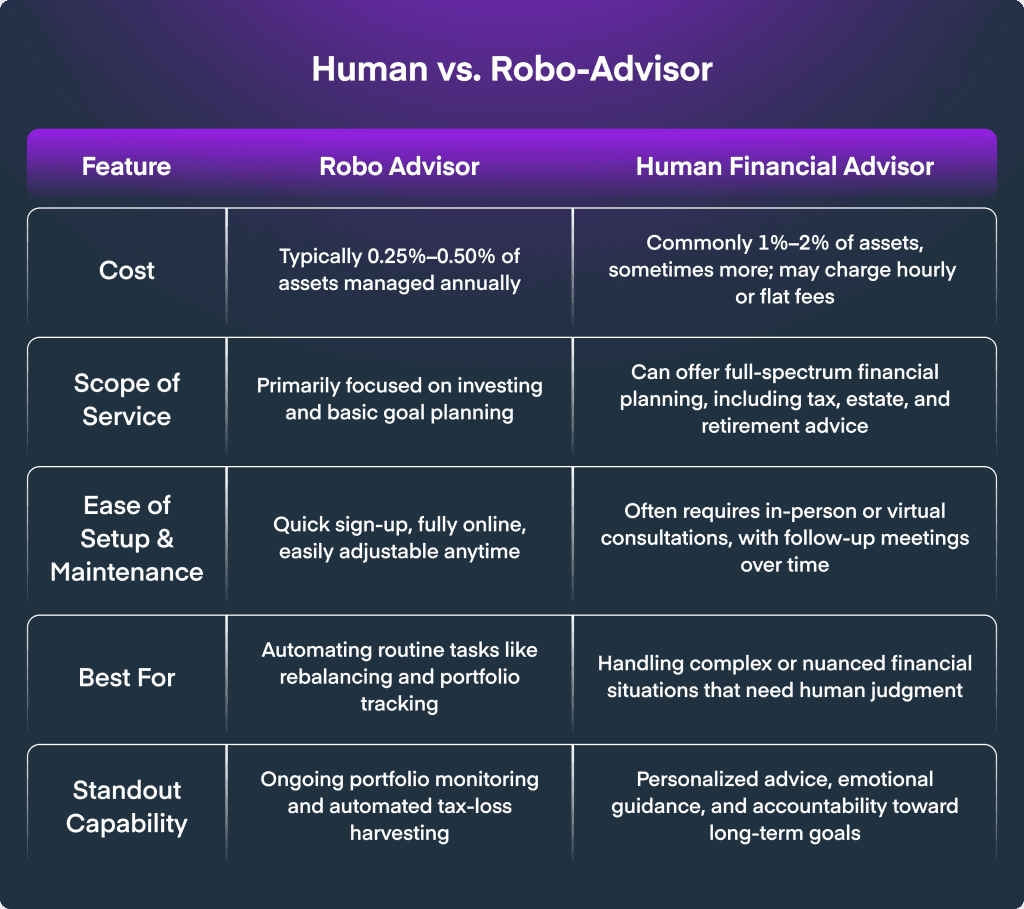
AI Financial Advisor vs Human Financial Advisor: Quick Comparison
Before diving into details, here’s a side-by-side look at how the two approaches typically compare.
| Factor | AI Financial Advisor | Human Financial Advisor |
| Cost | Generally lower advisory fees, often 0.25%-0.50% of assets or flat subscription fees | Typically higher, often 0.5%-1.5% of assets, hourly, or flat planning fees |
| Availability | 24/7 through an app or website | Limited to scheduled appointments or office hours |
| Investment management | Automated, algorithm-driven portfolio construction and rebalancing | Manually reviewed and adjusted, often with input from a team |
| Personalization | Based on data inputs like risk tolerance, goals, and time horizon | Can factor in nuanced personal circumstances and changing priorities |
| Automation | High; automatic rebalancing, tax-loss harvesting in some cases | Lower; changes usually require advisor action |
| Human interaction | Minimal or none, unless a hybrid service is used | Direct, ongoing relationship |
| Retirement planning | Can model basic retirement scenarios | Can build detailed, multi-account retirement strategies |
| Tax-related planning | Basic automated tax-efficiency features in some platforms | Can coordinate tax strategy with a CPA or tax professional |
| Emotional support | Limited; no behavioral coaching during market stress | Can provide reassurance and help prevent panic-driven decisions |
| Complex financial situations | Limited effectiveness for business owners, high-net-worth planning, or estate issues | Better suited for multi-layered financial planning |
| Best suited for | Beginners, hands-off investors, straightforward financial goals | People with complex finances or a strong preference for personal guidance |
Keep in mind that specific fees, features, and capabilities vary by provider. Always check a provider’s current disclosures before making a decision.
What Is an AI Financial Advisor?
An AI financial advisor, often called a robo-advisor, is a digital platform that uses algorithms to build and manage an investment portfolio based on information you provide, such as your age, income, goals, and risk tolerance.
Here’s generally how it works:
- Risk assessment. You answer a questionnaire covering your goals, time horizon, and comfort with market ups and downs.
- Asset allocation. The platform recommends a mix of investments, usually low-cost index funds or ETFs, based on your answers.
- Automated rebalancing. If your portfolio drifts from its target allocation because some investments grew faster than others, the system automatically adjusts it back.
- Financial planning tools. Many platforms include calculators for retirement savings, college costs, or general net worth tracking.
- Investment research. Some platforms summarize market data or fund information to help you understand what you’re invested in.
It’s important to distinguish between two very different things:
- A regulated robo-advisor or AI-powered advisory service. These are typically registered investment advisers under the Investment Advisers Act of 1940 and are subject to SEC or state regulatory oversight, including fiduciary obligations. You can look up a provider’s registration status through the SEC’s Investment Adviser Public Disclosure (IAPD) database on Investor.gov.
- A general-purpose AI chatbot, such as a consumer AI assistant not built or registered for investment advisory services. These tools can help you understand financial concepts, but they are not licensed advisors, are not bound by fiduciary duty, and should not be treated as a substitute for a regulated advisory service. For more on this distinction, see our complete guide to AI financial advisors.
If you’re researching a specific AI investing platform, it’s worth reviewing the risks of AI financial advisors before committing real money.
What Does a Human Financial Advisor Do?
A human financial advisor’s job goes well beyond picking investments. A good advisor typically works with you to:
- Understand your financial goals, from buying a home to funding a child’s education to retiring comfortably.
- Build an investment plan tailored to your full financial picture, not just a risk-tolerance score.
- Plan for retirement, including how to draw down 401(k), IRA, and taxable brokerage accounts in a tax-efficient order.
- Consider tax implications of investment decisions, often coordinating with a CPA or tax preparer.
- Coordinate estate planning basics, such as beneficiary designations, though actual estate documents usually require an attorney.
- Review insurance needs, like life or disability coverage, as part of an overall financial plan.
- Provide behavioral coaching, helping clients avoid emotionally driven decisions during volatile markets.
- Offer personalized guidance that accounts for your specific circumstances, not just generic best practices.
- Adjust the plan over time as life changes: a new job, a divorce, an inheritance, or a growing family.
This kind of ongoing, judgment-based relationship is difficult for software to fully replicate, especially when financial situations get complicated.
AI Financial Advisor vs Human Advisor: Cost
Cost is one of the most common reasons people compare these two options, but it’s not as simple as “AI is cheaper.” Total cost depends heavily on the specific provider and what’s included.
Costs commonly associated with AI financial advisors:
- Advisory or subscription fees, often a percentage of assets under management or a flat monthly fee
- Account minimums, which range from $0 to a few thousand dollars depending on the platform
- Underlying fund expense ratios (the cost of the ETFs or mutual funds used in your portfolio)
- Possible add-on fees for premium features, like access to a human advisor within a hybrid plan
Costs commonly associated with human financial advisors:
- Percentage-of-assets fees, frequently in a higher range than many robo-advisors
- Hourly or flat-fee financial planning, which can work out cheaper for people with straightforward, one-time planning needs
- Commission-based compensation in some cases, which is less common among fee-only advisors but still exists in parts of the industry
- Minimum account sizes that can be significantly higher than robo-advisor minimums
A low-cost AI platform with a high-expense-ratio fund lineup could end up costing more than a modestly priced human advisor who uses low-cost index funds. The only way to know for sure is to compare the full fee structure of each specific option you’re considering, not just the headline advisory fee.
Which Provides Better Investment Personalization?
Both approaches personalize your portfolio, but the depth of personalization differs.
How AI personalizes recommendations:
- Uses structured financial inputs like income, savings rate, and account balances
- Applies your stated risk tolerance to a model portfolio
- Factors in your goals and time horizon (for example, retirement in 25 years vs. a house down payment in 3 years)
- Adjusts allocations based on portfolio data as markets move
How a human advisor personalizes recommendations:
- Can discuss the full context behind your numbers, not just the numbers themselves
- Accounts for family changes, like a new child, a divorce, or supporting an aging parent
- Adjusts for career changes, such as a job loss, a big raise, or self-employment income
- Notices patterns in your financial behavior, like a tendency to panic-sell
- Responds to shifting priorities that a static questionnaire might not capture
- Talks through emotional reactions to market swings in real time
In short, AI personalization is data-driven, while human personalization is context-driven. Which one matters more to you often depends on how straightforward or complicated your financial life is.
Can AI Handle Complex Financial Planning?
AI tools are generally strong at structured, rules-based tasks. They tend to be less reliable for planning that involves judgment calls, legal nuance, or multiple moving parts.
Situations where AI-only tools often fall short include:
- Retirement planning involving multiple accounts, pensions, and Social Security timing decisions
- Tax-efficient withdrawals across taxable, tax-deferred, and Roth accounts
- Multiple income sources, including rental income, freelance income, or business income
- Business ownership, where personal and business finances are closely linked
- Inheritance planning, which can involve complex tax and legal considerations
- Estate planning, which typically requires coordination with an attorney
- High-net-worth situations, where strategies like trusts or advanced tax planning come into play
- Major life changes, such as divorce or a sudden windfall
AI-powered tools can assist with data analysis, scenario modeling, or organizing information for these situations. But when the stakes are high or the rules are complicated, many investors choose to work with a qualified human professional, such as a Certified Financial Planner (CFP), CPA, or estate attorney, rather than relying solely on automated tools.
AI vs Human Advisor During a Market Crash
Market downturns are often where the practical differences between AI and human advisors become most obvious.
What an AI financial advisor can do:
- Analyze your current portfolio’s exposure to specific sectors or asset classes
- Show you historical scenarios or hypothetical outcomes based on past data
- Automatically execute pre-set actions, like rebalancing or tax-loss harvesting
- Help you see, in numbers, how much of your portfolio is affected
What a human advisor can do:
- Explain current market conditions in plain language
- Offer behavioral guidance to help you avoid a fear-driven decision, like selling everything at a loss
- Reassure you based on your specific plan and timeline
- Adjust your plan if the downturn coincides with a personal financial change, like a job loss
Neither an AI tool nor a human advisor can predict or prevent market losses. Markets are inherently unpredictable, and past performance does not guarantee future results. What differs is the kind of support available while you wait out the volatility.
Is AI Better at Investment Research?
AI has clear strengths in processing information quickly. It can:
- Scan and summarize large volumes of financial documents, earnings reports, or news
- Highlight information investors may want to research further, such as changes in a fund’s holdings
- Organize research faster than a person reading the same material manually
However, speed is not the same as accuracy. AI tools can misinterpret data, rely on outdated information, or generate plausible-sounding but incorrect conclusions. Faster analysis does not mean reliable stock-price predictions, and no AI tool can consistently forecast market movements.
If you use AI for investment research, treat its output as a starting point, not a final answer. Verify important facts using reliable sources like company filings, SEC.gov, or established financial data providers before making decisions. For a broader look at this shift, see our article on how AI is changing investing.
Who Should Consider an AI Financial Advisor?
An AI financial advisor may be a reasonable fit if you:
- Want a largely automated, hands-off investing experience
- Have relatively straightforward finances, such as a single job, one or two retirement accounts, and clear goals
- Prefer managing money through an app rather than in-person meetings
- Value automatic portfolio rebalancing without having to request it
- Are comfortable evaluating and trusting a digital platform
- Don’t feel you need extensive, ongoing human guidance right now
This doesn’t mean AI tools are only for beginners. Some experienced investors use robo-advisors specifically because they want low-cost, automated portfolio management without paying for services they don’t need.
Who May Benefit More From a Human Financial Advisor?
A human financial advisor may be a better fit if you:
- Are approaching or in retirement and need detailed withdrawal and income planning
- Have complex tax situations, such as multiple income sources or significant capital gains
- Own a business and need to coordinate personal and business finances
- Have a high net worth with more complex investment or tax strategies
- Are dealing with complex estate planning, such as trusts or multi-generational wealth transfer
- Know you tend to make emotional decisions during market swings and want behavioral coaching
- Simply prefer building a long-term relationship with a person you can call or meet with directly
What About a Hybrid Approach?
Many US investors don’t have to choose one or the other. A growing number of financial firms now offer hybrid models that combine automated portfolio management with access to a human advisor.
What AI contributes in a hybrid model:
- Day-to-day automation, like rebalancing
- Fast data analysis and portfolio monitoring
- Research assistance and document summarization
What humans contribute in a hybrid model:
- Judgment on complex or unusual situations
- Context about your personal circumstances
- Accountability, someone to check in with regularly
- Behavioral and emotional guidance during stressful periods
- Complex planning across taxes, retirement, and estate considerations
A hybrid approach can make sense for investors who want the cost efficiency and automation of an AI platform but still want the option to talk to a person when bigger decisions come up.
AI Financial Advisor vs Human Advisor: Which Is Better?
There’s no universal answer to the AI financial advisor vs human advisor question. The better option depends on your specific situation, goals, and preferences. Use the table below as a general starting point, not a personalized recommendation.
| Your Situation | Option That May Be Suitable |
| You want automated investing | AI financial advisor |
| You have relatively simple finances | AI financial advisor |
| You need extensive retirement planning | Human financial advisor |
| You have complex tax issues | Human financial advisor |
| You need behavioral guidance during volatility | Human financial advisor |
| You want automation plus personal guidance | Hybrid approach |
This table is meant for general education. It is not personalized investment advice, and your own decision should account for your full financial picture, ideally with input from a qualified professional if your situation is complex.
7 Questions to Ask Before Choosing an AI or Human Financial Advisor
Before committing to any provider, ask:
- How much will I pay in total? Look beyond the headline advisory fee to underlying fund costs and any add-on charges.
- How is my portfolio managed? Understand whether decisions are fully automated, human-reviewed, or a mix of both.
- Who is responsible for investment decisions? Know whether you, an algorithm, or a licensed advisor is making the final call.
- Is the provider or advisor appropriately registered? Check status through the SEC’s IAPD database or your state securities regulator.
- How is my personal data protected? Ask about data security practices, especially for platforms handling sensitive financial information.
- Can I speak with a human if needed? Confirm whether human support is available, and under what circumstances or cost.
- What happens if my financial situation changes? Understand how the platform or advisor adjusts your plan after a major life event.
Common Mistakes to Avoid
- Choosing based only on low fees, without checking what services are actually included
- Assuming AI can predict the market, when no tool can reliably do this
- Ignoring investment costs, including fund expense ratios that quietly erode returns over time
- Not checking registration status before trusting a platform or individual with your money
- Sharing sensitive financial information with unreliable or unregulated AI tools
- Following AI-generated financial advice blindly, without verifying it against reliable sources
- Ignoring tax implications of investment decisions, especially withdrawals from retirement accounts
- Failing to understand the investment strategy behind your portfolio, whether it’s built by software or a person
Frequently Asked Questions
Is an AI financial advisor better than a human advisor? Neither is universally better. AI financial advisors tend to work well for straightforward, automated investing, while human advisors tend to add more value for complex financial planning and behavioral guidance. The right choice depends on your individual circumstances.
Are AI financial advisors cheaper? Often, but not always. Many AI platforms have lower advisory fees than traditional human advisors, but total cost also depends on underlying fund expenses and any add-on features. Always compare the full fee structure, not just the advisory fee.
Can AI replace financial advisors? AI can replace some functions of a financial advisor, particularly automated portfolio management and basic financial planning tools. It’s less able to replace judgment-based guidance, behavioral coaching, and complex, multi-layered financial planning.
Is AI safe for investing? Regulated robo-advisors are subject to SEC or state oversight and fiduciary obligations, similar to other registered investment advisers. General-purpose AI chatbots are not licensed advisors and shouldn’t be relied on as a sole source of investment advice. Always verify a provider’s registration and security practices.
Can AI financial advisors manage retirement accounts? Many robo-advisor platforms support IRAs and Roth IRAs, and some offer basic 401(k) guidance or rollover assistance. Whether a specific platform supports your account type depends on the provider, so check directly with them.
Should beginners use an AI financial advisor? AI financial advisors can be a reasonable starting point for beginners with straightforward goals, thanks to lower minimums and simplified account setup. Beginners with more complex situations, or who want more guidance, may benefit from speaking with a human advisor as well.
What is the difference between a robo-advisor and an AI financial advisor? The terms are often used interchangeably. Generally, “robo-advisor” refers to a regulated, algorithm-based investment advisory service, while “AI financial advisor” can also include broader AI tools used for financial planning or research, which may not carry the same regulatory status. Always confirm whether a specific tool is a licensed advisory service before relying on it for investment decisions.
Final Thoughts
AI financial advisors offer real advantages: automation, fast data analysis, lower costs in many cases, and round-the-clock convenience. Human financial advisors offer something different: deeper personalization, professional judgment, and support for complex financial situations that go beyond what an algorithm can currently handle.
Neither approach is universally better. The right choice comes down to how complex your finances are, how much personal support you want, what you’re willing to pay, and your own comfort with technology versus in-person guidance. Many investors find that a hybrid approach, combining automated tools with occasional access to a human professional, offers the best of both.
Whichever direction you choose, take the time to research any provider or advisor carefully, verify their registration status, and understand exactly how your money will be managed before you commit.
Sources
- U.S. Securities and Exchange Commission, Investor Bulletin: Robo-Advisers – https://www.investor.gov
- SEC Division of Investment Management, IM Guidance Update on Robo-Advisers – https://www.sec.gov
- Financial Industry Regulatory Authority (FINRA) – https://www.finra.org
- Internal Revenue Service, Retirement Plans (401(k), IRA, Roth IRA guidance) – https://www.irs.gov
- Board of Governors of the Federal Reserve System – https://www.federalreserve.gov
About the Author
Vimal Kumar writes about personal finance, investing, and financial technology for FinovaInsights, focusing on helping everyday US investors understand how new tools and traditional advice fit into their financial planning. This article is for general educational purposes and does not constitute personalized financial advice.
Financial Disclaimer
This article is for educational and informational purposes only and does not constitute personalized financial, investment, tax, or legal advice. Investing involves risk, including the potential loss of principal, and past performance does not guarantee future results. Before making financial decisions, consider consulting a qualified financial advisor, tax professional, or attorney, and verify important information with authoritative sources such as the SEC, FINRA, or IRS.