

China vs US AI race in 2026: a data-driven look at computing power, frontier models, AI investment and research, using Stanford, Epoch AI and CSIS data.
The US-China AI Race Is More Complicated Than a Single Score
AI leadership is not one contest; it’s a bundle of related but distinct competitions, and a country can be winning several at once while losing others. The main dimensions worth tracking include:
- Computing capacity — how much raw processing power a country’s data centers and clusters can bring to bear on training and running models
- Semiconductor access — whether a country can buy, or build, the advanced chips that computing capacity depends on
- Data centers — the physical facilities, power supply and networking that turn chips into usable compute
- Model quality — how frontier systems perform on benchmarks and in real-world use
- AI adoption — how widely businesses and individuals actually use AI tools, which doesn’t always track model quality
- Private investment — how much capital flows into AI companies and infrastructure
- Research output — publications, citations and patents that measure a country’s scientific contribution to the field
- Talent — where the engineers and researchers who build these systems choose to work
- Commercialization — how effectively a country turns AI research into products and revenue
A country that leads on one axis can trail badly on another, and that’s exactly the pattern 2026 has produced.
1. Computing Power: The US Maintains a Major Lead
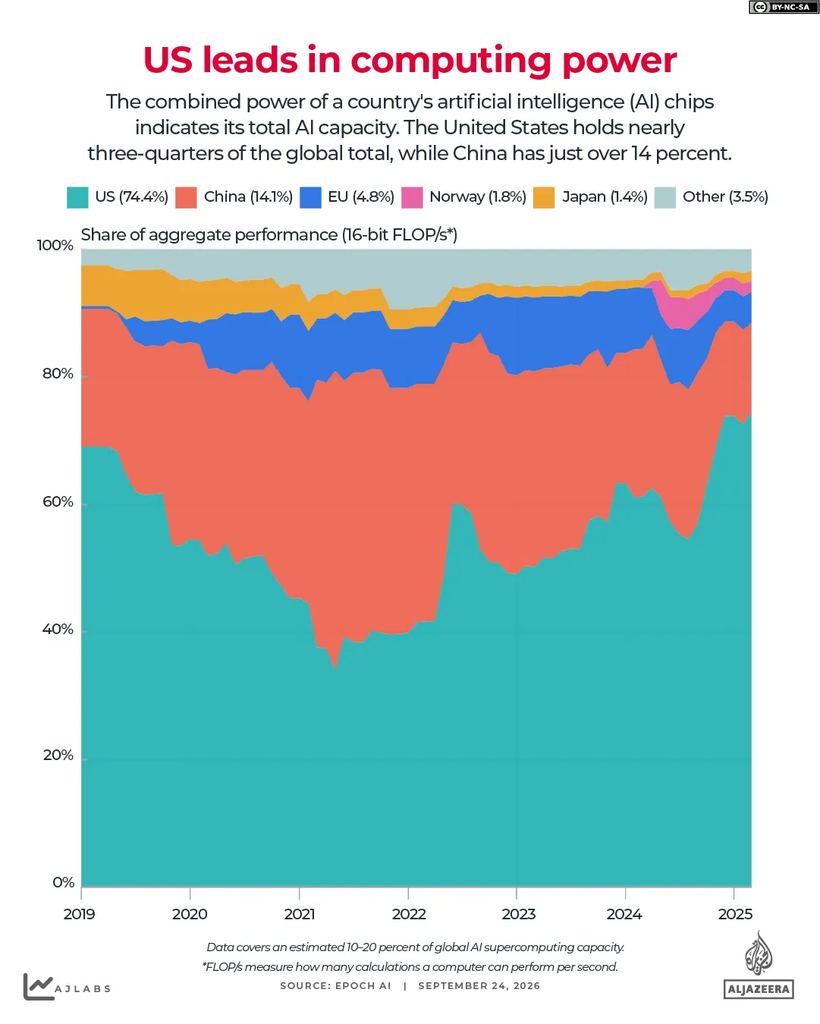
On raw computing capacity, the United States still holds a commanding position. Research organization Epoch AI, which tracks global compute distribution, has found that the United States holds roughly 75% of global GPU cluster performance as of 2026. That’s a lead built on years of hyperscaler infrastructure spending and near-total access to Nvidia’s most advanced accelerators, which remain the industry’s dominant training and inference hardware.
China’s position looks different depending on how the compute is counted. Officially, Nvidia has been effectively locked out of China’s data-center market by export controls; the company’s own annual report states plainly that it was foreclosed from competing in China’s data-center computing market as of fiscal year 2026, and that this foreclosure helped its competitors build larger developer ecosystems worldwide. But that doesn’t mean China has no access to advanced foreign chips. Epoch AI’s compute-smuggling research estimates that between 290,000 and 1.6 million H100-equivalent chips were diverted to China through 2025, with a median estimate of about 660,000 units, roughly a third of the country’s total compute.
Domestically, Huawei has become China’s default AI chip supplier by necessity as much as merit. Estimates vary by analyst, but multiple 2026 reports describe Nvidia’s China market share collapsing from roughly 95% before the export controls to a low single-digit or near-zero share today, with Huawei’s Ascend line, especially the Ascend 950PR that entered mass production in March 2026, absorbing most of the domestic demand. Brokerage estimates cited by Fast Company and the Associated Press project Huawei’s China AI chip market share rising to roughly 50% by the end of 2026, up from a much smaller base in 2025, while Nvidia’s share in the same market shrinks toward single digits.
A simple compute snapshot:
| Metric | United States | China |
| Share of global GPU cluster performance | ~75% (Epoch AI, 2026) | Minority share; growing domestic base |
| Primary AI chip supplier | Nvidia (Blackwell/Hopper generations) | Huawei Ascend (950-series), plus Cambricon, SMIC-fabricated chips |
| Access to leading-edge foreign chips | Full, domestic manufacturers | Restricted by export controls; partially offset by smuggling and workarounds |
| 2026 hyperscaler/big-tech capex | ~$725–830B (Big Four US hyperscalers, TrendForce estimate) | ~$100B combined (Alibaba, Tencent, ByteDance, Baidu, TrendForce estimate) |
Export controls remain the biggest wildcard here. They’ve clearly slowed China’s access to the newest Nvidia silicon, but multiple industry voices, including Nvidia CEO Jensen Huang, have argued publicly that the restrictions accelerated China’s push toward chip self-sufficiency rather than stalling its AI progress outright. Whether that trade-off favors US policy goals in the long run remains genuinely unresolved.
2. AI Models: China Is Closing the Gap
If computing power still tilts toward the US, model performance has moved sharply in China’s direction. According to Stanford HAI’s 2026 AI Index Report, the performance gap between the top US and top Chinese models has compressed to roughly 2.7% as of March 2026, down from a range of 17.5 to 31.6 percentage points across major benchmarks in 2023. Stanford’s researchers note that US and Chinese models have traded the lead multiple times since early 2025, and that DeepSeek-R1 briefly matched the top US model in February 2025 before being overtaken again.
That narrowing has happened alongside a structural shift in how AI models reach developers. American labs, OpenAI, Google, Anthropic and xAI, continue to lead in closed-source, proprietary frontier systems; Stanford’s data shows the top closed model now leads the top open model by a wider margin than in 2024, and six of the top ten Arena-leaderboard models are closed-source, a tier the US companies dominate. If you’re tracking what these newest systems can actually do, our coverage of GPT-6 Astra and the latest frontier AI models breaks down what’s changed at the top of that leaderboard.
China’s advantage sits elsewhere: open-weight models. Alibaba’s Qwen family has become, by multiple measures, the most widely used open model line in the world. Hugging Face’s own “State of Open Models” analysis found Qwen to be the community’s most popular base model, with roughly 151,000 derivatives on the Hub and 39.6 million monthly GGUF downloads, more than five times the volume of Meta’s Llama. DeepSeek, Zhipu AI’s GLM, Moonshot’s Kimi and other Chinese labs have followed a similar playbook: publish capable models under permissive licenses, undercut proprietary API pricing, and let global developer adoption do the rest. That’s part of why understanding what AI agents are and how they work increasingly means understanding which base model sits underneath them, since Chinese open-weight models now power a large share of agentic tooling built outside China too.
It’s important not to over-read any single leaderboard. Benchmark scores measure specific tasks, not general intelligence, and a 2.7% Arena-score gap doesn’t mean the two countries’ AI industries are functionally tied. What it does mean is that the assumption of a durable, multi-year American model-quality lead no longer holds the way it did in 2023.
3. AI Investment: The US Is Spending More
On raw dollars, there’s no contest. Stanford’s AI Index puts US private AI investment at $285.9 billion in 2025 against China’s $12.4 billion, a roughly 23-to-1 ratio, though the report cautions that this understates China’s total effort because it excludes state-directed funding; Stanford’s researchers estimate that Chinese government guidance funds deployed roughly $184 billion into AI firms between 2000 and 2023, outside the private-investment tally.
At the infrastructure level, the imbalance is just as stark. Industry tracking from TrendForce put combined 2026 capital expenditure across nine major global cloud providers, Google, AWS, Meta, Microsoft, Oracle, ByteDance, Tencent, Alibaba and Baidu, at roughly $830 billion, with the four largest US hyperscalers alone accounting for roughly $725 billion of that, up about 77% from approximately $410 billion in 2025. Amazon, Microsoft, Alphabet and Meta are each individually spending more on 2026 AI infrastructure than China’s four largest AI spenders combined; TrendForce’s 2026 estimate puts Alibaba, Tencent, ByteDance and Baidu’s combined capital expenditure at approximately $100 billion, roughly one-seventh of the comparable US total.
That spending buys several distinct things:
- GPUs and AI accelerators — the chips that do the actual training and inference work
- Data centers — the physical buildings, cooling systems and networking that house those chips
- Energy infrastructure — power generation and grid capacity, an increasingly binding constraint on both sides
- Cloud capacity — the platforms that rent out compute to third-party developers and enterprises
- Model development — the research and engineering cost of training frontier systems in the first place
It’s worth stressing that spending scale doesn’t map directly onto AI outcomes. Chinese firms benefit from meaningfully lower data-center construction and power costs, which lets them build comparable usable capacity for less money in absolute dollar terms. And as the model-performance data above shows, DeepSeek’s initial breakthrough came from a research team spending a fraction of what US labs were spending on training compute, a reminder that capital intensity and capability aren’t always tightly linked. For a look at how this spending race is already reshaping which AI products actually reach paying customers, see AI tools developers are actually using in 2026 and the changing economics of frontier AI models, both of which track how cost pressure is changing what developers and enterprises choose to build on.
4. AI Research: China Has Become a Major Competitor
This is the dimension where China’s lead is least ambiguous, at least by volume. The World Intellectual Property Organization’s Technology SPARK Report found that China-based inventors published over 43,000 generative-AI patent families in 2024 and 2025 combined, exceeding the country’s entire cumulative output from 2014 to 2023, with a compound annual growth rate of 64% between 2023 and 2025. On publications, Stanford’s 2026 Index credits China with 23.2% of global AI publication output, alongside 69.7% of global AI patent filings, both comfortably ahead of the United States by volume.
But volume and impact are different measurements, and the sources are consistent on this distinction. WIPO’s own reporting notes that only 7.3% of China’s generative-AI patent filings between 2014 and 2023 were made internationally, and that China’s AI-related patent grant ratio was just 32% according to an April 2024 government data release, well below grant ratios in countries like Japan and Canada. On the research side, Stanford’s report is direct about where the balance still sits: the US continues to produce more top-tier AI models and higher-impact patents, while China leads in publication volume, citation counts, patent output and industrial robot installations.
Talent flows add another wrinkle. The same Stanford report found that AI talent migration into the United States has dropped 89% since 2017, a trend researchers partly attribute to tightened visa policy, which matters because talent concentration has historically been one of America’s clearest structural advantages in AI research.
US vs China AI: Four Key Areas Compared
| Category | United States | China |
| Computing infrastructure | ~75% of global GPU cluster performance (Epoch AI); full access to Nvidia’s newest chips; dominant hyperscaler data-center footprint | Minority global compute share; growing domestic chip base (Huawei Ascend) plus diverted foreign chips estimated at roughly a third of total compute (Epoch AI) |
| Frontier models | Leads closed-source frontier tier; top model held a 2.7% Arena-score edge as of March 2026 (Stanford HAI); dominant in proprietary API models | Near-parity on top-model benchmarks; dominant in open-weight model adoption globally (Qwen, DeepSeek, GLM, Kimi) |
| AI investment | 285.9Bin2025privateAIinvestment;~725B in 2026 hyperscaler capex alone (Stanford HAI, TrendForce) | $12.4B in 2025 private AI investment, plus an estimated 184Bincumulativestateguidancefundsthrough2023;~100B in 2026 big-tech capex (Stanford HAI, TrendForce) |
| AI research | Produces more top-tier notable models and higher-impact, more-cited patents (Stanford HAI) | Leads in publication volume (23.2% of global output), patent filings (69.7% of global total) and patent growth rate (WIPO) |
No category here produces a clean, uncontested “winner,” which is the point.
Why China Can Still Challenge the US Despite the Chip Gap
China’s path to remaining competitive doesn’t run through matching US compute dollar-for-dollar. It runs through a different set of advantages:
- Domestic chip development — Huawei’s Ascend 950-series, along with Cambricon and SMIC-fabricated alternatives, are closing the practical performance gap for inference workloads even if they trail Nvidia’s newest chips on raw training throughput
- Open-weight models — giving away Qwen- and DeepSeek-class model weights has built a global developer base that closed, paywalled competitors can’t easily dislodge
- Lower inference costs — Chinese labs have consistently shipped models at a fraction of comparable US API pricing, which matters enormously as inference, not training, becomes the dominant share of global AI compute spend
- A large engineering talent pool — China continues to graduate large numbers of STEM researchers, even as the country’s net AI-talent migration abroad has also shifted
- Government support — state guidance funds and industrial policy have backstopped semiconductor and AI investment in ways that smooth over some of the private-capital gap
- Rapid commercialization and industrial deployment — Stanford’s data on industrial robot installations, roughly nine times the US rate, points to how quickly Chinese firms move AI and automation research into factory-floor use
Why the US Still Has Important Structural Advantages
The American position isn’t just about spending more; it’s about a set of interlocking advantages that are hard to replicate quickly:
- Leading AI companies — OpenAI, Google DeepMind, Anthropic and xAI continue to set the pace on the most capable proprietary systems
- An advanced semiconductor ecosystem — Nvidia’s chip design leadership, paired with TSMC’s manufacturing capability (available to US firms but not, under current export rules, to China), remains a chokepoint China hasn’t closed
- Nvidia and accelerator availability — American companies have essentially unrestricted access to the newest training and inference hardware
- Cloud infrastructure at scale — AWS, Azure and Google Cloud give US AI companies a global distribution and deployment backbone
- Deep venture capital markets — the $285.9 billion private AI investment figure reflects a capital-markets depth China’s more state-directed financing system doesn’t fully replicate
- Sustained data-center investment — the roughly $725 billion in 2026 hyperscaler capex is building compute capacity years ahead of what current AI revenue alone would justify
The Role of Nvidia, Huawei and AI Chips
Semiconductor access sits underneath almost every other part of this competition, because it determines the ceiling on how much AI computing a country can actually deploy. It helps to separate what’s actually involved:
- Designing AI chips — Nvidia and Huawei both design their own accelerator architectures (Blackwell-class chips on one side, Ascend-series on the other)
- Manufacturing chips — this is where the real chokepoint sits. Nvidia’s designs are fabricated by TSMC using the world’s most advanced lithography; Huawei’s Ascend chips rely on SMIC, China’s most advanced domestic foundry, which remains several process generations behind TSMC and lacks access to the newest extreme ultraviolet lithography tools
- Packaging — advanced chip packaging (stacking memory and compute dies) is its own specialized bottleneck, and one where China has been investing heavily to reduce dependence on foreign suppliers
- Data-center deployment — having chips is different from deploying them at gigawatt scale with adequate power, cooling and networking
- Building complete AI computing systems — the hardest part is combining all of the above into a reliable, software-supported platform; Nvidia’s CUDA ecosystem remains a major advantage that Huawei’s CANN software stack is still working to match
Precise performance comparisons between the newest Nvidia and Huawei chips vary significantly by source, workload and precision format, and should be treated cautiously; what’s better established is the market-share trend, Huawei’s rapid gains in China’s domestic market as Nvidia’s access has been restricted.
What the AI Race Means for Businesses and Investors
The practical implications of this competition extend well beyond the two countries directly involved:
- Cloud computing — capacity constraints at US hyperscalers, driven by the sheer scale of AI capex, are already affecting availability and pricing for enterprise cloud customers
- Semiconductor companies — export-control policy has become a direct driver of revenue and market share for chipmakers on both sides, and further policy shifts remain a live risk factor
- Data centers — power availability, not chip supply, is increasingly the binding constraint on how fast new AI capacity can come online in both countries
- Energy demand — AI data-center buildouts are becoming a measurable factor in national electricity demand growth, particularly in the US
- Enterprise software — falling inference costs, driven partly by competition from Chinese open-weight models, are lowering the price of embedding AI into business software
- AI startups — companies building on top of foundation models now have a genuine choice between expensive proprietary US APIs and cheaper, capable open-weight alternatives, which is reshaping how startups budget for AI infrastructure
- Financial markets — AI infrastructure spending has become a significant driver of US equity market performance, concentrated in a small number of hyperscaler and chip stocks
This has real consequences for how AI is being deployed in financial services specifically. For a closer look at how these dynamics are playing out on trading desks, see how agentic AI is changing Wall Street, and for how falling model costs are reshaping consumer-facing financial tools, see AI financial advisors and how they are changing investing. This is educational context rather than investment advice, and anyone weighing exposure to this trend should treat AI infrastructure spending as one input among many, alongside using AI for investment research more broadly, rather than a signal to act on directly.
What Could Change the Balance in 2027 and Beyond?
Several factors could shift this competition meaningfully over the next one to two years, in either direction:
- More efficient AI models — continued algorithmic efficiency gains, which Epoch AI estimates at roughly 3x per year, could reduce the importance of raw compute advantage
- Domestic Chinese semiconductor advances — further progress from SMIC, Huawei and emerging players in advanced packaging and lithography could narrow China’s manufacturing gap faster than currently expected
- US export controls — policy changes, in either direction, remain one of the single largest variables; the current rules have already reshaped market share dramatically once
- New generations of AI accelerators — each new Nvidia and Huawei chip generation resets the performance comparison
- Energy availability — whichever country solves power-grid and generation constraints fastest may gain a practical compute advantage regardless of chip supply
- AI inference economics — as inference overtakes training as the dominant compute workload, cost-efficient open-weight models could gain disproportionate influence over global AI adoption
- Open-source and open-weight models — continued Chinese dominance in open-weight distribution could shape which models become de facto global standards, independent of which country’s models are technically superior
- Government policy — industrial policy, subsidies and research funding decisions in both countries will continue to shape long-term trajectories
- Breakthroughs in AI research — a genuine architectural or training breakthrough from either country’s labs could reset the competition on short notice, as DeepSeek’s early 2025 release demonstrated
None of these point clearly toward one country pulling decisively ahead; if anything, the pattern across all four dimensions in 2026 has been convergence, not divergence.
Final Takeaway
The US and China are not running the same race, even though they’re often described that way. The United States holds a substantial, well-documented advantage in computing infrastructure and private-sector AI investment, spending roughly 23 times more in private capital and controlling around three-quarters of global GPU cluster performance. China has made real, measurable progress on model quality, closing a benchmark gap that stood at 17 to 31 percentage points in 2023 down to roughly 2.7% by early 2026, while building a commanding lead in AI research publication volume and patent filings.
Model quality, cost structures, chip access and developer adoption can all shift within a single product cycle, as DeepSeek’s early 2025 breakthrough and Huawei’s rapid 2026 market-share gains have both shown. That volatility is exactly why the AI competition between these two countries resists a single scoreboard. Anyone looking for a definitive answer to “who’s winning” in 2026 is asking the wrong question; the more useful one is which specific capability matters most for a given use case, because on that question, the US and China currently lead in different, and shifting, places.
FAQ
Is China ahead of the US in AI in 2026?
Not overall, no. China has narrowed the model-performance gap to roughly 2.7% and leads in research publication volume and patent filings, but the US maintains a substantial lead in computing infrastructure (~75% of global GPU cluster performance) and private AI investment (about 23 times China’s level), according to Stanford HAI’s 2026 AI Index.
Why did Nvidia’s market share in China collapse?
US export controls have progressively restricted Nvidia’s ability to sell its most advanced AI chips into China’s data-center market. Nvidia’s own 2026 annual report states the company was effectively foreclosed from China’s data-center computing market, which has allowed domestic suppliers like Huawei to rapidly gain share.
Are Chinese AI models as good as US models?
On benchmark performance, the gap has narrowed dramatically, from a 17.5 to 31.6 percentage-point US lead in 2023 to roughly 2.7% as of March 2026, per Stanford’s AI Index. However, the top proprietary US models still hold the overall performance lead, and China’s biggest advantage has been in widely adopted open-weight models rather than topping every benchmark outright.
How much more is the US spending on AI than China?
Significantly more. Stanford’s 2026 AI Index puts 2025 US private AI investment at $285.9 billion versus China’s $12.4 billion. On infrastructure capex specifically, the four largest US hyperscalers plan to spend roughly $725 billion in 2026, versus an estimated $100 billion combined for China’s four largest tech spenders.
Does China lead in AI research?
By volume and patent filings, yes: China accounts for about 69.7% of global AI patent filings and 23.2% of global AI publication output, per Stanford’s 2026 data. But the US continues to produce more top-tier notable AI models and higher-impact, more-cited patents, so the two countries lead on different measures of research output.
2 Comments