

Learn 7 year-end tax planning strategies for 2026, including charitable deductions, investment gains, retirement contributions and new US tax rules.
Year-End Tax Planning for 2026: 7 Smart Moves Investors and Families Should Consider
As 2026 approaches its final months, US taxpayers have an important opportunity to review their finances and prepare for the upcoming tax filing season. Recent federal tax legislation has introduced changes to deductions, charitable contributions and other tax provisions that could influence how individuals, families and investors manage their money.
For many households, year-end tax planning is not simply about reducing a tax bill. It is also about understanding how income, investment decisions, retirement contributions and eligible deductions interact before the calendar year closes.
The One Big Beautiful Bill Act introduced several changes affecting the 2026 tax year, including a deduction for certain charitable cash contributions by taxpayers who do not itemize and new rules for itemized charitable deductions. Other provisions involving qualified tips, overtime compensation, vehicle loan interest and seniors may also affect eligible taxpayers. The Internal Revenue Service has published guidance on these changes. Read the IRS overview of the tax law.
In this guide, FinovaInsights explains seven practical areas to review before December 31, 2026. The goal is to help readers understand the available opportunities, identify potential tax risks and prepare questions for a qualified tax professional.
1. Review Your Income Before the End of the Year
One of the most important steps in year-end tax planning is estimating your total annual income.
Your adjusted gross income (AGI) can influence eligibility for certain deductions, credits and government benefits. Changes in employment income, bonuses, investment gains, retirement distributions or self-employment earnings may affect your final tax position.
For example, an investor who plans to sell appreciated stocks late in December should consider how the resulting capital gain could affect their overall taxable income. Similarly, a worker expecting a year-end bonus may want to review withholding and estimated tax payments before the year closes.
Consider reviewing:
- Salary, bonuses and other employment income.
- Self-employment and freelance earnings.
- Dividends, interest and capital gains.
- Retirement account distributions.
- Potential deductions and tax credits.
- Estimated tax payments and withholding.
Why it matters: Understanding your likely annual income before making major financial decisions can help you avoid unexpected tax liabilities and identify legitimate planning opportunities.
Taxpayers should also remember that a deduction does not necessarily reduce their tax bill dollar for dollar. The actual benefit depends on the applicable tax rules and their individual circumstances.
2. Understand the 2026 Health Insurance Subsidy Rules
Health insurance costs can be an important part of financial planning for Americans who purchase coverage through the Affordable Care Act (ACA) marketplace.
Premium tax credits help eligible households pay for qualifying marketplace health insurance. However, eligibility and the amount of assistance available can depend on household income, family size and other requirements.
Changes affecting premium tax credits mean that people who receive advance subsidies should carefully review their projected 2026 household income rather than automatically assuming their existing assistance will continue unchanged.
Income changes may result from:
- A salary increase or year-end bonus.
- Capital gains from selling investments.
- Additional freelance or business income.
- Retirement account withdrawals.
- Changes in household composition.
People who receive advance premium tax credits should keep their marketplace income estimates current and understand the potential consequences of receiving more assistance than they ultimately qualify for.
Some eligible individuals may also benefit from health savings account (HSA) contributions when paired with a qualifying high-deductible health plan. However, eligibility requirements and contribution limits apply, and HSA contributions are not a universal solution for every taxpayer.
Practical tip: If you buy health insurance through the ACA marketplace, review your projected annual income and subsidy eligibility before making large financial moves near year-end.
For official information, visit HealthCare.gov and consult the latest IRS guidance on the premium tax credit.
3. Take Advantage of the New Charitable Deduction Rules
Charitable giving is another area that deserves attention during year-end planning.
Beginning with tax year 2026, eligible taxpayers who claim the standard deduction may be able to deduct certain cash contributions to qualified charitable organizations. The maximum deduction is $1,000 for eligible individual filers and $2,000 for eligible married couples filing jointly, subject to the applicable requirements.
This creates a potential tax benefit for some households that previously received no separate federal charitable deduction because they did not itemize.
For example, suppose an eligible married couple makes $2,000 in qualifying cash donations during 2026 and claims the standard deduction. If they qualify for the full charitable deduction, that amount may reduce their taxable income by $2,000.
The actual tax savings depend on their circumstances and marginal tax rate. A $2,000 deduction is not the same as receiving $2,000 back from the government.
Before making a donation, consider the following:
- Confirm that the organization qualifies under IRS rules.
- Keep receipts and other appropriate records.
- Make qualifying contributions within the relevant tax year.
- Check whether the contribution must be made in cash.
- Review the requirements for your filing status.
The new deduction has specific restrictions. For example, donations of appreciated stock and contributions to certain donor-advised funds do not qualify for the non-itemizer cash deduction.
For more details, review the IRS charitable contribution guidance.
4. Consider Charitable Giving Through Appreciated Investments
Taxpayers who itemize deductions and have investments that have increased in value may want to examine their charitable giving strategy more carefully.
Donating appreciated securities directly to an eligible charitable organization may offer different tax advantages from selling those investments and donating the remaining cash. Depending on the asset, holding period, recipient and applicable rules, a qualifying donation may allow a taxpayer to avoid realizing capital gains on the donated asset while potentially claiming an eligible charitable deduction.
However, the 2026 tax law introduces additional restrictions for itemized charitable deductions.
For 2026, charitable contributions claimed by itemizers are generally deductible only to the extent that eligible contributions exceed 0.5% of adjusted gross income, subject to other applicable limitations. Taxpayers in the highest marginal income tax bracket may also face a limitation on the tax benefit of itemized deductions.
These changes can affect how donors evaluate the timing and size of their contributions.
What is a donor-advised fund?
A donor-advised fund is a charitable giving arrangement that allows eligible donors to contribute assets to a sponsoring organization and recommend grants to qualified charities over time.
Some taxpayers consider contributing appreciated securities to a donor-advised fund as part of a broader charitable strategy. This may help them separate the timing of their charitable contribution from the timing of distributions to individual charities.
Another approach is called charitable bunching. Instead of spreading planned donations evenly across several years, a taxpayer may concentrate multiple years of intended gifts into one year. Depending on their deductions and circumstances, this can affect whether itemizing provides a greater benefit than taking the standard deduction.
Neither strategy guarantees tax savings. Donors should compare the new deduction rules, potential capital gains consequences and their long-term charitable intentions before acting.
5. Review Your Investment Gains and Losses
Investors with taxable brokerage accounts should review their portfolios before the end of the year.
Selling an investment for more than its tax basis may create a capital gain. Selling an investment at a loss may create a capital loss that can potentially offset capital gains, subject to applicable tax rules.
This process is commonly called tax-loss harvesting.
For example, an investor might have realized a gain from selling one stock earlier in the year and still hold another investment that has declined in value. Selling the second investment could potentially offset some of the first investment’s capital gain.
However, investors should not sell assets solely to pursue a tax benefit without considering their broader financial objectives.
Before making a decision, review:
- The difference between short-term and long-term capital gains.
- Your realized gains and losses for the year.
- The tax basis of investments you may sell.
- The potential effect on your overall taxable income.
- The wash-sale rules and their application to your transactions.
- Your investment goals and desired portfolio allocation.
Capital losses may be subject to restrictions on how they can be used, and wash-sale rules can disallow certain losses when substantially identical securities are acquired within the relevant period.
Investors should also consider whether selling an asset would disrupt a long-term investment plan.
If you are learning how investment structures affect taxation, explore our guide to mutual funds versus ETFs for beginners in the US. The article explains important differences between these investment options, including their potential tax implications.
6. Check Whether You Qualify for New Tax Deductions
The One Big Beautiful Bill Act introduced several deductions that may apply to eligible taxpayers, depending on their income, employment, age and other circumstances.
These provisions do not mean that all tips, overtime earnings or vehicle loan interest are automatically tax-free. Each deduction has its own definitions, eligibility conditions and limitations.
Qualified tip income
Eligible workers who receive qualifying tips may be able to claim a deduction, subject to applicable rules and income limits. The deduction is not available for every kind of income or every worker who receives a gratuity.
Qualified overtime compensation
Certain workers may be eligible to deduct qualifying overtime compensation. The deduction applies to eligible overtime pay under the law’s requirements, not necessarily every dollar an employer labels as overtime.
Eligible vehicle loan interest
Some taxpayers may qualify for a deduction for interest on qualifying passenger vehicle loans. Requirements include rules relating to the vehicle, the loan, income and other conditions.
Additional deduction for seniors
Eligible taxpayers aged 65 and older may qualify for an additional deduction, subject to applicable income and filing requirements.
These provisions may create opportunities, but eligibility should be verified carefully rather than assumed.
Taxpayers should maintain appropriate documentation and consult the latest IRS instructions before filing. The IRS provides information about the new deductions through its Working Families Tax Cuts resources.
7. Organize Retirement Contributions and Year-End Financial Records
Retirement planning should also be part of your year-end financial review.
Contributions to eligible retirement accounts may provide tax advantages, depending on the account type, the taxpayer’s eligibility and the applicable contribution rules.
For example, traditional retirement accounts may offer a current deduction for qualifying contributions, while Roth accounts generally use after-tax contributions and provide different tax treatment for qualified withdrawals.
However, not every retirement contribution is deductible, and contribution deadlines are not identical across all account types.
Before making an additional contribution, check:
- The applicable annual contribution limit.
- Whether your income affects eligibility.
- Whether you have already contributed through an employer plan.
- Whether your employer offers matching contributions.
- Whether the account provides a current deduction or future tax advantages.
- The deadline for making a contribution that qualifies for the intended tax year.
You should also gather tax documents before the filing season becomes busy.
Useful records include income statements, investment transaction reports, charitable donation receipts, retirement contribution statements, health savings account records and documentation supporting any deductions you intend to claim.
Keeping these records organized can make it easier to prepare an accurate tax return and respond to questions about your deductions.
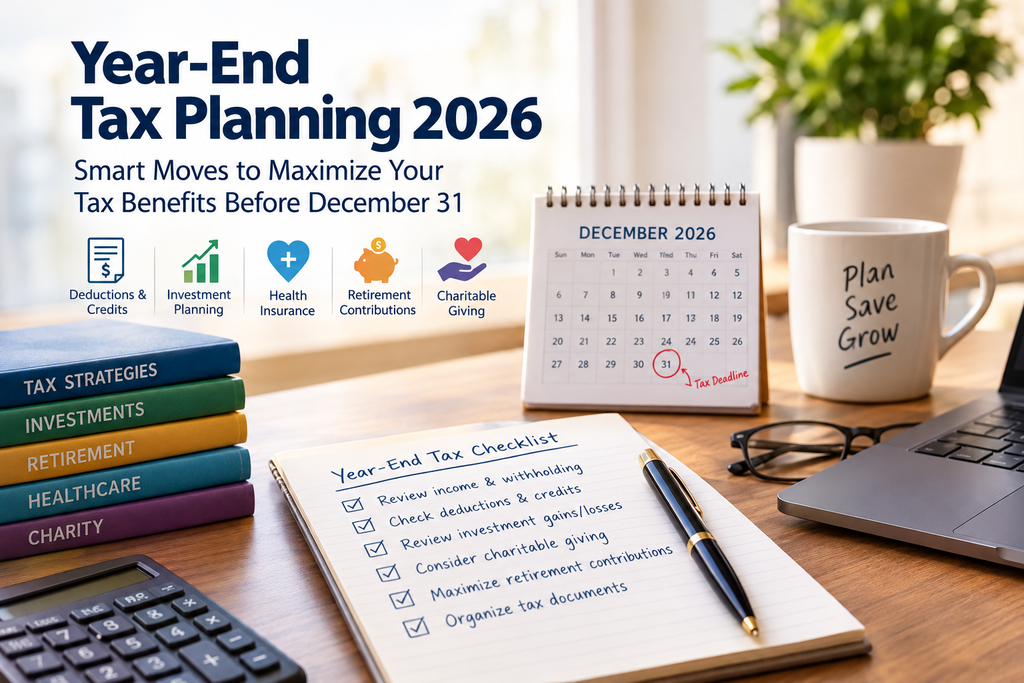
A Simple Year-End Tax Planning Checklist for 2026
Use this checklist to prepare for the final months of the year.
- Estimate your total 2026 income.
- Review withholding and estimated tax payments.
- Check your eligibility for deductions and credits.
- Review ACA marketplace health insurance subsidies, if applicable.
- Confirm that charitable donations meet the relevant requirements.
- Review realized investment gains and losses.
- Understand any tax consequences before selling investments.
- Check retirement account contribution limits and deadlines.
- Gather receipts and supporting financial records.
- Consult a qualified tax professional about complex decisions.
The most useful steps will vary depending on your income, filing status, investments and financial goals. You do not need to use every strategy on this list for year-end planning to be valuable.
Frequently Asked Questions
What is year-end tax planning?
Year-end tax planning involves reviewing income, deductions, investments and eligible tax benefits before the end of the tax year. The goal is to make informed financial decisions and prepare for the upcoming tax filing season.
What are the major tax changes to understand for 2026?
Among the changes to review are the deduction for certain charitable cash contributions by non-itemizers, new restrictions affecting itemized charitable deductions and provisions involving qualifying tips, overtime compensation, vehicle loan interest and seniors. Eligibility requirements differ across provisions.
Can charitable donations reduce my taxes in 2026?
Potentially. Eligible non-itemizers may deduct qualifying cash contributions up to the applicable limit. Taxpayers who itemize must follow the rules and limitations that apply to their charitable deductions.
Should I sell losing investments before December 31?
Not automatically. Tax-loss harvesting may help offset capital gains, but you should also consider investment objectives, wash-sale rules, transaction costs and the long-term implications of selling an asset.
Can retirement contributions reduce taxable income?
Some qualifying contributions to traditional retirement accounts may reduce taxable income, but the rules depend on the account type, income, eligibility and contribution limits. Roth contributions generally do not provide an immediate federal income tax deduction.
When should I speak to a tax professional?
Consider professional guidance if you have substantial investment gains, complex charitable contributions, changing health insurance subsidies, significant retirement distributions or uncertainty about your eligibility for new deductions.
Final Thoughts
Year-end tax planning in 2026 requires more than simply looking for additional deductions. Changes in federal tax law may affect how Americans evaluate income, charitable donations, investment gains, retirement contributions and health insurance benefits.
Reviewing your finances before December 31 can help you identify potential issues while there is still time to consider appropriate actions. Keep supporting records, verify eligibility using official IRS guidance and avoid making major investment or charitable decisions based solely on an expected tax benefit.
Most importantly, remember that the best approach depends on your individual financial circumstances. A strategy that benefits one household may not be suitable for another.
Disclaimer: This article is for informational and educational purposes only. It does not constitute tax, legal, financial or investment advice. Tax laws, eligibility requirements and deduction limits may change. Consult the IRS or a qualified tax professional before making decisions about your individual tax situation.
About FinovaInsights: FinovaInsights publishes educational content about finance, investing, business and technology to help readers better understand important financial developments and make informed decisions.
Sources and References
- IRS — Working Families Tax Cuts: https://www.irs.gov/newsroom/working-families-tax-cuts
- IRS — Guidance for Individuals and Workers: https://www.irs.gov/newsroom/working-families-tax-cuts-individuals-and-worker
- HealthCare.gov — Health Insurance Marketplace: https://www.healthcare.gov/